
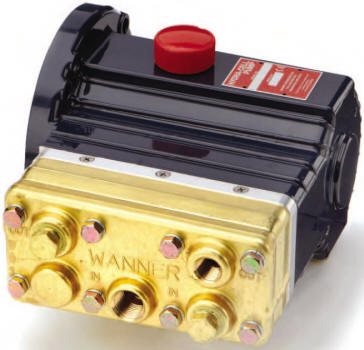
Following is the digital version of the model D/G/M 03 The Wanner Hydra-Cell Pro® Pump IOM and parts manual file D10-991-2400-Rev-D.pdf; use the navigation bar above to jump to the applicable section.
D/G-03 Series Specifications
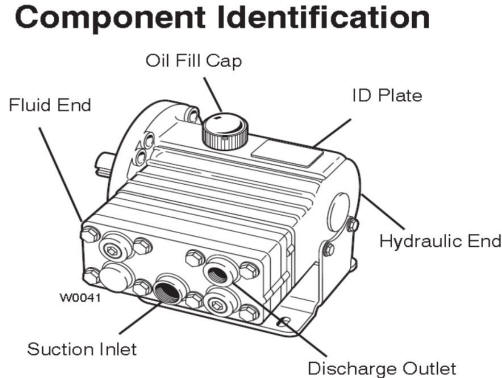
Pressure and Capacity
| Max Pressure | |
|---|---|
| Metallic Heads: D/G-03-X, D/G-03-E (Kel-Cell)* |
1000 psi (70 bar) |
| Metallic Heads (non Kel-Cell): D/G-03-S, B, G |
1200 psi (83 bar) |
| Non-Metallic Heads: All models |
250 psi (17 bar) |
| Capacity @ Max Pressure | |||
|---|---|---|---|
| Model | RPM | GPM | L/min |
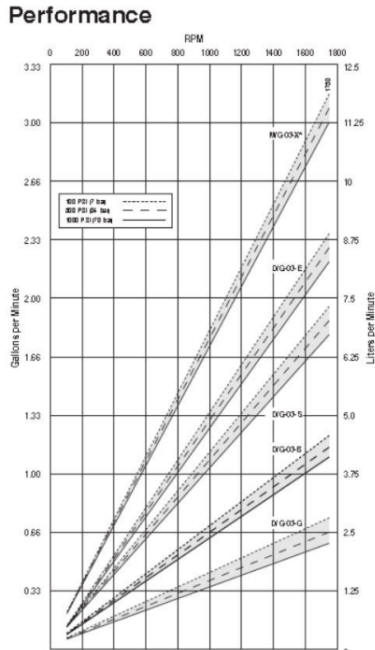
| D/G-03-X (including Kel-Cell)* | 1750 | 3.0 | 11.3 |
| D/G-03-E (including Kel-Cell)* | 1750 | 2.2 | 8.3 |
| D/G-03-S | 1750 | 1.8 | 6.8 |
| D/G-03-B | 1750 | 1.1 | 4.2 |
| D/G-03-G | 1750 | 0.5 | 1.9 |
Delivery (Discharge per Revolution)
| Delivery @ Max Pressure | ||
|---|---|---|
| Model | revs/gal | revs/liter |
| D/G-03-X (including Kel-Cell)* | 584 | 155 |
| D/G-03-E (including Kel-Cell)* | 795 | 204 |
| D/G-03-S | 972 | 258 |
| D/G-03-B | 1591 | 415 |
| D/G-03-G | 3500 | 906 |
* Kel-Cell available in X and E models only. Performance ratings apply to all configurations unless noted otherwise.
Calculating Required Horsepower (kW)
Electric Motor kW = [ (6 x rpm) / 84,428 ] + [ (lpm x bar) / 511 ]
rpm equals pump shaft rpm. HP/kW is required application power. Use caution when sizing motors with variable speed drives.
Technical Details
| Shaft Diameter |
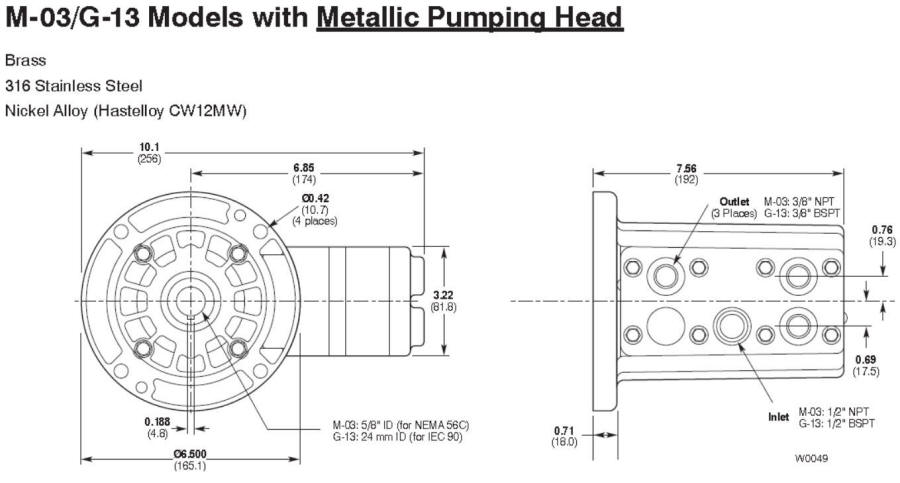
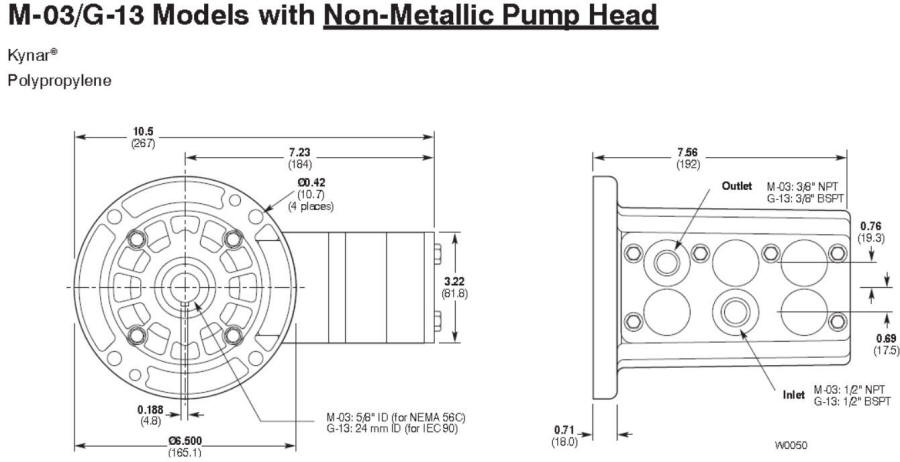
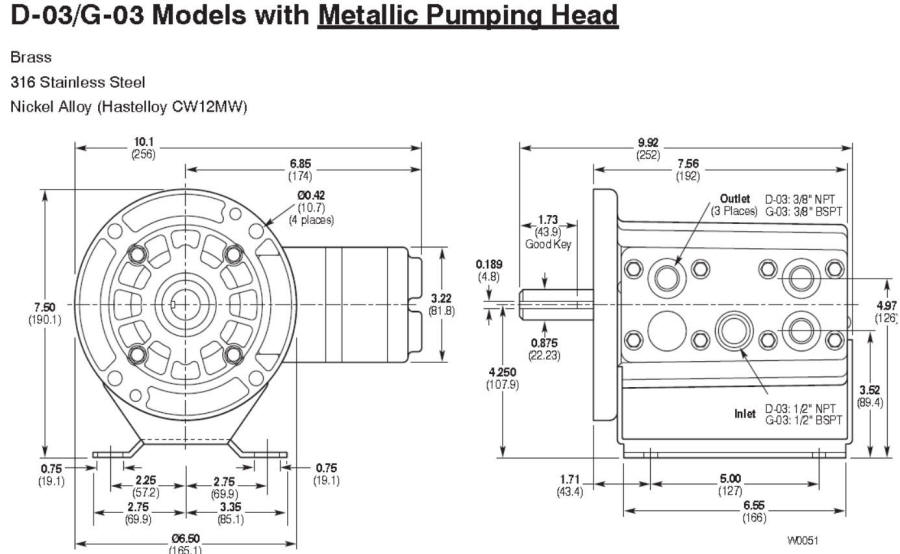
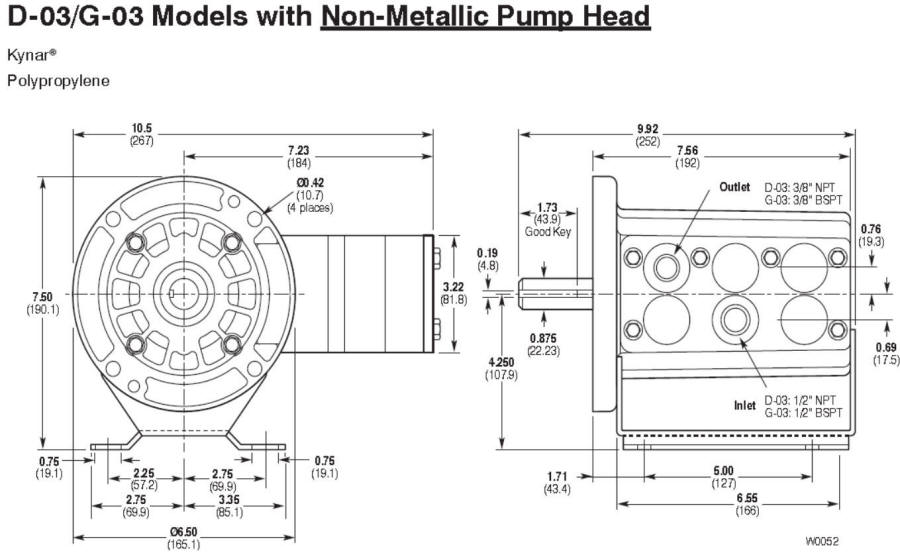
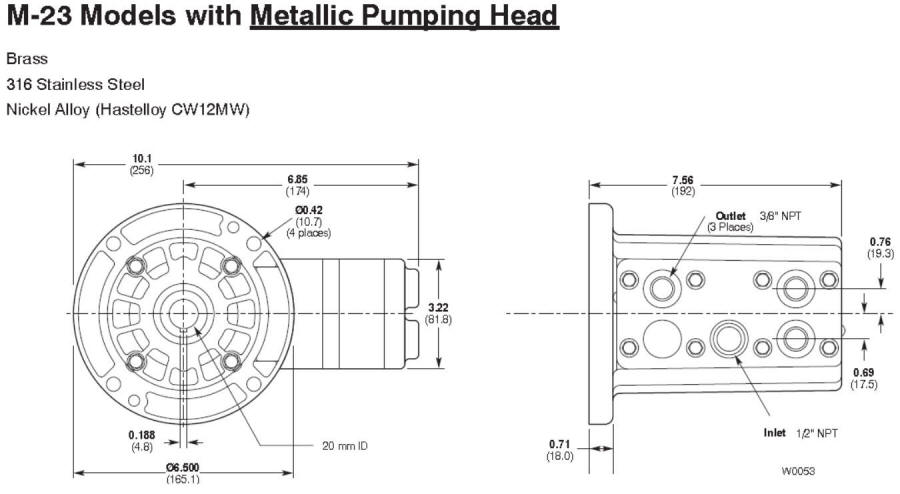
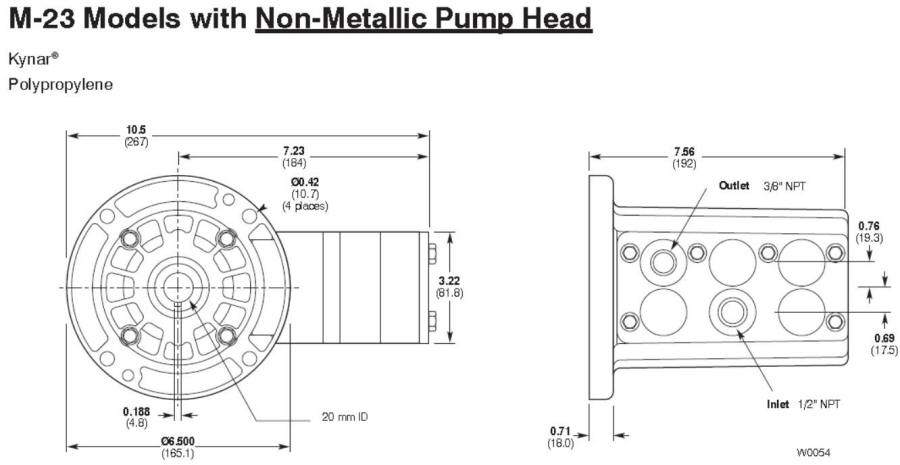
D-03/G-03: 7/8 inch (22.22 mm) solid shaft M-03: 5/8 inch hollow (for NEMA 56C C-Face motor) G-13: 24 mm hollow shaft (for IEC 90L, B5 Flange motor) M-23: 20 mm hollow shaft (for use with Honda Engine) |
| Shaft Rotation | Bi-directional |
| Bearings | Ball bearings |
| Oil Capacity | 1.0 US quart (0.95 liters) |
| Max Inlet Pressure | 250 psi (17 bar) |
| Max Temperature |
Metallic Heads: 250°F (121°C) - consult factory for over 160°F (71°C) Non-Metallic Heads: 140°F (60°C) |
| Inlet Port | D-03, M-03, M-23: 1/2" NPT | G-03, G-13: 1/2" BSPT |
| Discharge Port | D-03, M-03, M-23: 3/8" NPT | G-03, G-13: 3/8" BSPT |
| Weight | Metallic: 28 lbs (12.7 kg) | Non-Metallic: 19 lbs (8.6 kg) |
D/G-03 Installation
Location
Locate the pump as close to the supply source as possible. Install it in a lighted clean space where it will be easy to inspect and maintain. Allow room for checking the oil level, changing the oil, and removing the pump head (manifold, valve plate and related items).
Mounting
The pump shaft can rotate in either direction. To prevent vibration, securely attach the pump (D-03, G-03) or motor (M-03, M-23, G-13) to a rigid base.
- Belt-Drive Systems: Align the sheaves accurately; poor alignment wastes horsepower and shortens the belt and bearing life. Make sure the belts are properly tightened, as specified by the belt manufacturer.
- Direct-Drive Systems: Align the shafts accurately. Unless otherwise specified by the coupling manufacturer, maximum parallel misalignment should not exceed .015" and angular misalignment should be held to 1 degree maximum. Careful alignment extends life of the coupling, pump, shafts, and support bearings.
- Close-Coupled Systems: Coat the motor shaft liberally with anti-seize.
Important Precautions
Adequate Fluid Supply
To avoid cavitation and premature pump failure, be sure that the pump will have an adequate fluid supply and that the inlet line will not be obstructed. See "Inlet Piping" section for details.
Positive Displacement
This is a positive-displacement pump. To avoid severe system damage if the discharge line ever becomes blocked, install a relief valve downstream from the pump. See "Discharge Piping" section.
Safety Guards
Install adequate safety guards over all pulleys, belts, and couplings. Follow all codes and regulations regarding installation and operation of the pumping system.
Shut-Off Valves
Never install shut-off valves between the pump and discharge pressure regulator, or in the regulator bypass line.
Freezing Conditions
Protect the pump from freezing. Refer to the Maintenance Section for specific procedures.
Consult the Factory for the following situations:
- Extreme temperature applications (above 160°F or below 40°F)
- Pressure feeding of pumps
- Viscous or abrasive fluid applications
- Chemical compatibility problems
- Hot ambient temperatures (above 110°F)
- Conditions where pump oil may exceed 200°F (an oil cooler may be required)
D/G-03 Installation (Inlet Piping)
Inlet Piping (Suction Feed)
Caution: When pumping at temperatures above 160° F (71° C), use a pressure-feed system.
- Install drain cocks at any low points of the suction line to permit draining in freezing conditions.
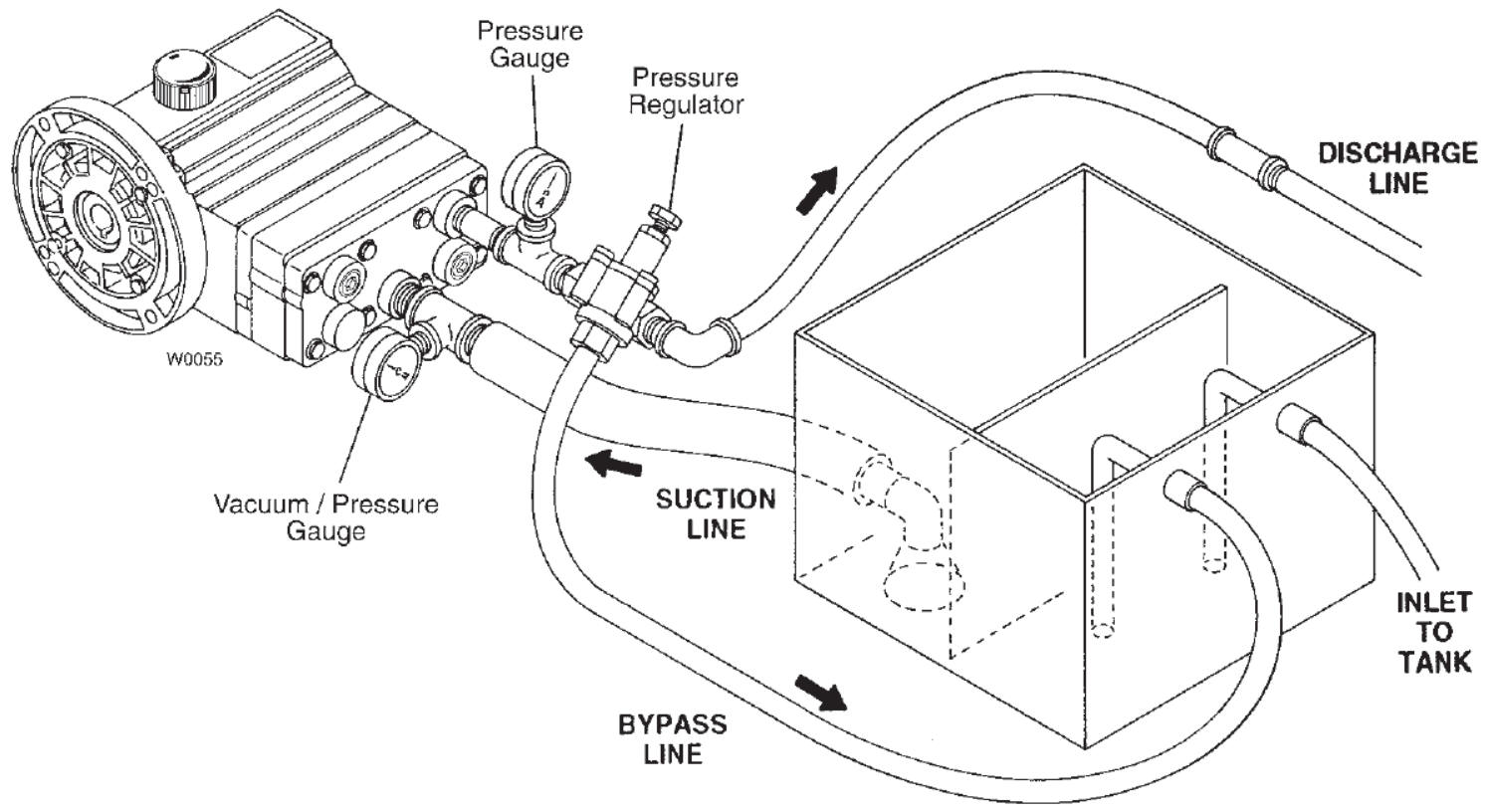
- Provide for permanent or temporary installation of a vacuum gauge to monitor the inlet suction.
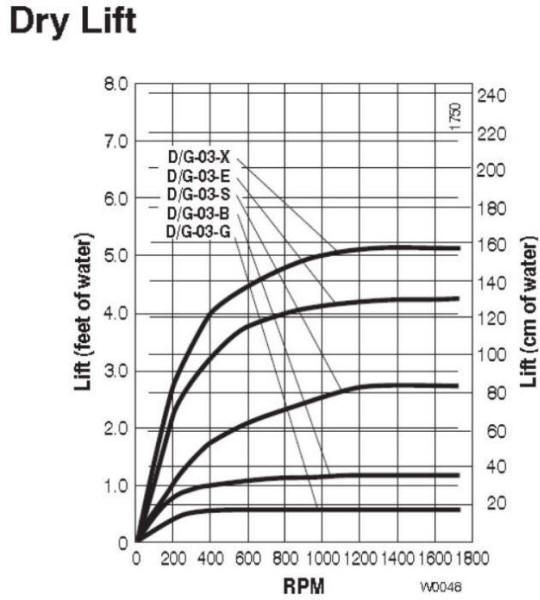
- To maintain maximum flow, vacuum at the pump inlet should not exceed 7 in. Hg at 3 gpm and 70° F (180 mm Hg at 11.4 liters/min and 21° C).
- Do not supply more than one pump from the same inlet line.
- With PTFE diaphragms, the inlet must be flooded.
Supply Tank
- Use a supply tank large enough to provide time for any trapped air in the fluid to escape. The tank size should be at least twice the maximum pump flow rate.
- Isolate the pump and motor stand from the supply tank and support them separately.
- Install a separate inlet line from the supply tank to each pump.
- Install the inlet and bypass lines so they empty into the supply tank below the lowest water level, on the opposite side of the baffle from the pump suction line.
- If a line strainer is used, install it in the inlet line to the supply tank.
- To reduce aeration and turbulence, install a completely submerged baffle plate to separate incoming and outgoing liquids.
- Install a vortex breaker in the supply tank over the outlet port to the pump.
- Place a cover over the supply tank to prevent foreign objects from falling into it.
Hose and Routing
Size the suction line at least one size larger than the pump inlet so that velocity will not exceed 1-3 ft/sec (0.3 to 0.9 m/sec).
Velocity (m/sec) = 21.2 × LPM / Pipe ID2
- Keep the suction line as short and direct as possible.
- Use flexible hose and/or expansion joints to absorb vibration, expansion, or contraction.
- If possible, keep the suction line level. Do not have high points to collect vapor unless they are vented.
- To reduce turbulence and resistance, do not use 90° elbows. Use 45° elbows or sweeping curves in flexible inlet hose if turns are necessary.
- If a block valve is used, ensure it is fully opened; the opening should be at least the same diameter as the inlet plumbing ID.
- Do not use a line strainer or filter in the suction line unless regular maintenance is assured. If used, it should have a free-flow area at least three times the free-flow area of the inlet.
- Install piping supports where necessary to relieve strain on the inlet line and minimize vibration.
Inlet Piping (Pressure Feed)
- Provide for permanent or temporary installation of a vacuum/pressure gauge to monitor the inlet.
- Pressure at the pump inlet should not exceed 250 psi (17.3 bar); if it could get higher, install an inlet pressure regulator.
- Do not supply more than one pump from the same inlet line.
Inlet Calculations
Acceleration Head
Use the following formula to calculate acceleration head losses. Subtract this figure from the NPSHa and compare it to the NPSHr of the Wanner Hydra-Cell Pro® pump.
Where:
- Ha: Acceleration head (ft of liquid)
- L: Actual length of suction line (ft)
- V: Velocity of liquid in suction line (ft/sec) [V = GPM × (0.408 ÷ pipe ID2)]
- N: RPM of crank shaft
- C: Constant (0.066 for M-03, D-03, M-23, G-03 and G-13)
- K: Constant for fluid compressibility (1.4 for de-aerated/hot water; 1.5 for most liquids; 2.5 for high-compressibility hydrocarbons)
- G: Gravitational constant (32.2 ft/sec2)
Friction Losses
Frictional losses in the suction piping are negligible (Hf = 0) for water-like fluids when following minimum hose I.D. and maximum length recommendations.
For more-viscous fluids (lubricating oils, sealants, etc.), frictional losses may become significant, decreasing NPSHa and causing cavitation. Frictional losses increase with increasing viscosity, suction-line length, and flowrate, or decreasing line diameter.
Consult the factory before pumping viscous fluids.
Minimizing Acceleration Head and Frictional Losses
- Keep inlet lines less than 3 ft (1 m) long.
- Use at least 5/8 in. (16 mm) I.D. inlet hose.
- Use soft, non-collapsing, low-pressure hose for inlet lines.
- Minimize fittings (elbows, valves, tees, etc.).
- Use a suction stabilizer on the inlet.
D/G-03 Installation and Start-Up
Net Positive Suction Head (NPSH)
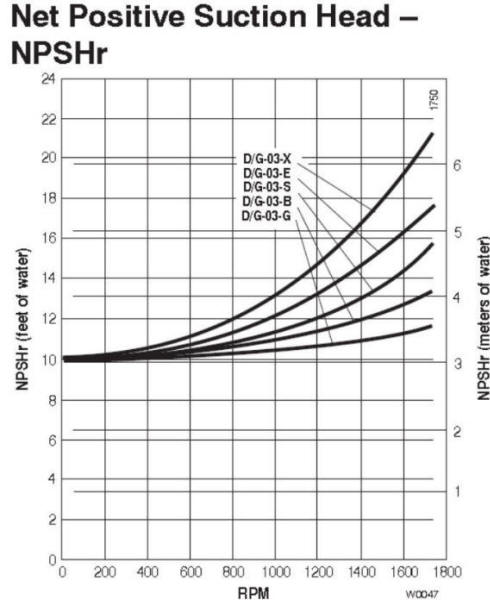
NPSHa must be equal to or greater than NPSHr. If not, the pressure in the pump inlet will be lower than the vapor pressure of the fluid and cavitation will occur.
Calculating the NPSHa
Use the following formula to calculate the NPSHa:
Where:
- Pt: Atmospheric pressure
- Hz: Vertical distance from surface liquid to pump center line (if liquid is below pump center line, the Hz is negative)
- Hf: Friction losses in suction piping
- Ha: Acceleration head at pump suction
- Pvp: Absolute vapor pressure of liquid at pumping temperature
NOTES:
- In good practice, NPSHa should be 2 ft greater than NPSHr.
- All values must be expressed in feet of liquid.
Atmospheric Pressure at Various Altitudes
| Altitude (ft) | Pressure (ft of H2O) | Altitude (ft) | Pressure (ft of H2O) |
|---|---|---|---|
| 0 | 33.9 | 1500 | 32.1 |
| 500 | 33.3 | 2000 | 31.5 |
| 1000 | 32.8 | 5000 | 28.2 |
Discharge Piping
Note: Consult the Factory before manifolding two or more pumps together.
Hose and Routing
- Use the shortest, most-direct route for the discharge line.
- Select pipe or hose with a working pressure rating of at least 1.5 times the maximum system pressure.
- Use approximately 6 ft (1.8 m) of flexible hose between the pump and rigid piping to absorb vibration and expansion.
- Support the pump and piping independently.
- Size the discharge line so that the velocity will not exceed 7-10 ft/sec (2-3 m/sec).
Pressure Regulation
- Install a pressure regulator or unloader in the discharge line.
- Bypass pressure must not exceed the pressure limit of the pump.
- Locate the regulator as close to the pump as possible and ahead of any other valves.
- Adjust the regulator to no more than 10% over the maximum working pressure of the system.
- Route the bypass line to the supply tank, or to the suction line as far from the pump as possible (to reduce the effects of downtime and turbulence).
- If the pump will be operating with the discharge closed for long periods, install a thermal protector in the bypass line, to trip at 140° F (60° C).
- For additional system protection, install a safety relief valve in the discharge line, downstream from the pressure regulator.
CAUTION: Never install shut-off valves in the bypass line or between the pump and the pressure regulator/relief valve.
Before Initial Start-Up
Before you start the pump, be sure that:
- All shut-off valves are open, and the pump has an adequate supply of fluid.
- All connections are tight.
- The oil level is 3/4 in. (20 mm) from the top of the fill port.
- The relief valve on the outlet of the pump is adjusted so the pump starts under minimum pressure.
- All pulleys and belts are properly aligned, and belts are tensioned according to specification.
- All pulleys and belts have adequate safety guards.
Initial Start-Up Procedure
- Turn on power to the pump motor.
- Check the inlet pressure or vacuum. To maintain maximum flow, inlet vacuum must not exceed 7 in. Hg at 70° F (180 mm Hg at 21° C). Inlet pressure must not exceed 250 psi (17.3 bar).
- Listen for any erratic noise and look for unsteady flow.
- If the system has an air lock and the pump fails to prime:
- Turn off the power.
- Open one outlet port.
- Briefly restart the system and operate it until fluid comes out the outlet port.
- Turn off the power and reinstall the outlet port plug.
- Adjust the discharge pressure regulator to the desired operating and bypass pressures. Do not exceed the maximum pressure rating of the pump.
- After the pressure regulator is adjusted, set the "pop-off" safety relief valve at 100 psi (6.9 bar) higher than the desired operating pressure.
D/G-03 Maintenance
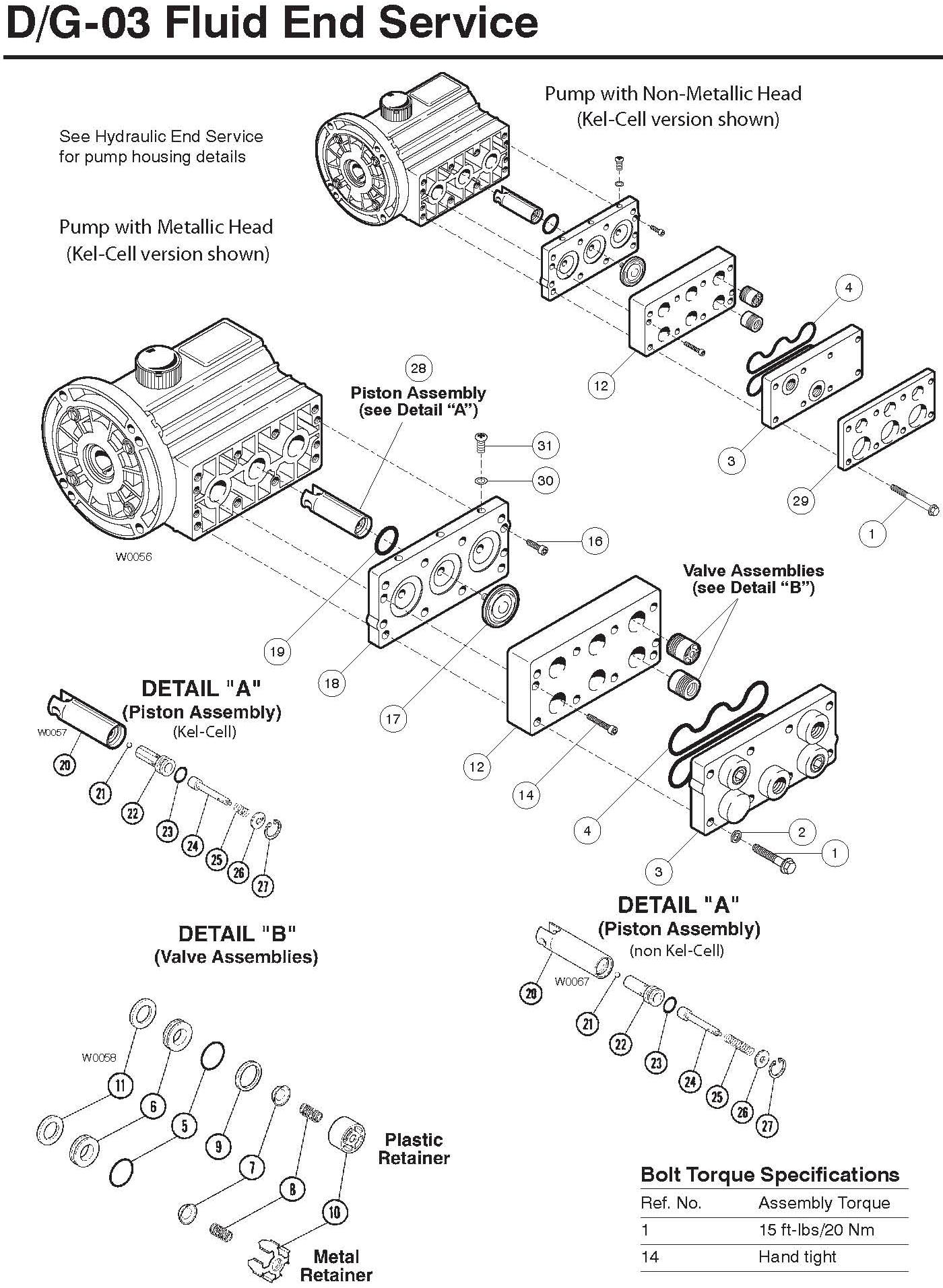
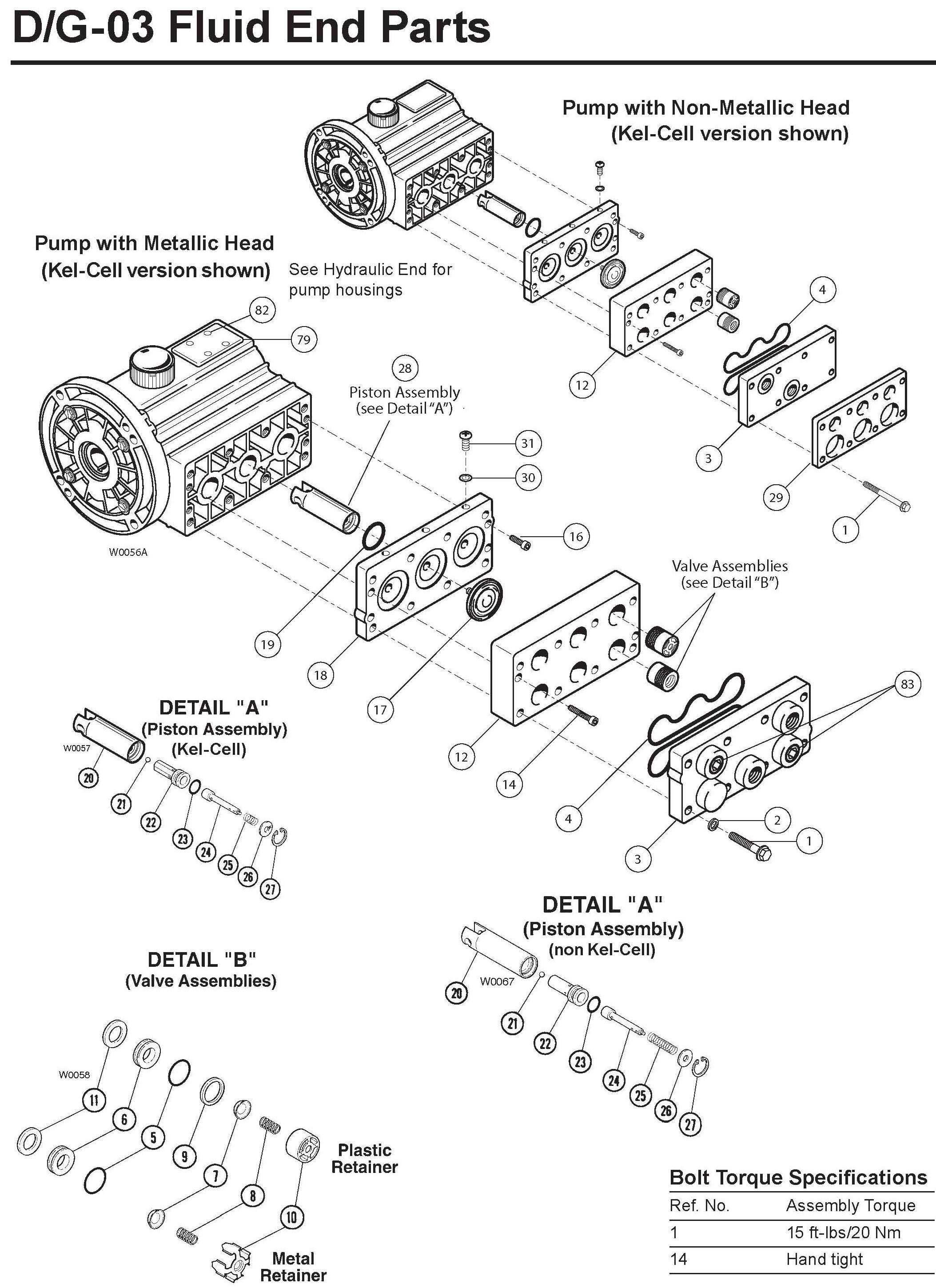
NOTE: The numbers in parentheses are the Ref. Nos. on the illustrations in the Parts Manual.
Daily Maintenance
- Check the oil level and the condition of the oil. The oil level should be 3/4 in. (20 mm) from the top of the fill port.
- Use the appropriate Wanner® Hydra-Oil brand motor oil for the application (contact Wanner® Engineering if in doubt).
Caution: If you are losing oil but don't see any external leakage, or if the oil becomes discolored and contaminated, one of the diaphragms (17) may be damaged. Refer to the Service Section. Do not operate the pump with a damaged diaphragm.
Caution: Do not leave contaminated oil in the pump housing or leave the housing empty. Remove contaminated oil as soon as discovered, and replace it with clean oil.
Periodical Maintenance
Change the oil after the first 100 hours of operation, then change according to the guidelines below. When changing, remove the drain plug (60). Allow all oil and contaminant to drain out.
Hours Between Oil Changes @ Various Process Fluid Temperatures
| Pressure | RPM | <90°F (32°C) | <139°F (60°C) | <180°F (82°C) |
|---|---|---|---|---|
| Metallic Pump Head <800 psi (55 bar) |
<1200 | 8,000 | 5,000 | 3,000 |
| <1800 | 4,000 | 3,000 | 2,000 | |
| Metallic Pump Head <1200 psi (83 bar) |
<1200 | 4,000 | 3,000 | 2,000 |
| <1800 | 2,000 | 1,500 | 1,000 | |
| Non-Metallic Pump Head <250 psi (17 bar) |
<1800 | 4,000 | 3,000 | — |
NOTE: Minimum oil viscosity for proper hydraulic end lubrication is 16-20 CST (80-100 SSU).
CAUTION: Do not turn the drive shaft while the oil reservoir is empty.
Shutdown Procedure & Storage
If the pump is to be lifted or stored for a long period (more than six months), or if it is to be exposed to freezing temperatures, follow this procedure:
- Flush the pump with a solution of water and a rust-inhibitor.
- Stop the pump.
- Drain the liquid from the pump and suction/discharge lines.
- Fill the pump with an antifreeze/water solution if it will be exposed to freezing temperatures.
- To facilitate restarting, follow step 4 of the Initial Start-up Procedure to clear any air locks.
- When antifreeze is flowing from the system return line, stop the pump. Connect the return line back to the supply tank and circulate for a short period.
- It is good practice to change the oil in the Hydraulic End before storage to remove accumulated condensation and sediment. Drain and refill with appropriate Hydra-Oil and operate for a short period.
CAUTION: Protect the pump from freezing. Refer also to the "Shutdown Procedure".
Request a Quote or Call us at 908.362.9981 to speak with a sales engineer
D/G-03 Fluid End Service (All versions)
This section explains how to disassemble and inspect all easily-serviceable parts of the pump. Repair procedures for the hydraulic end (oil reservoir) of the pump are included in a later section of the manual.
Note: The numbers in parentheses are the Ref. Nos. on the illustrations in the Parts Manual.
Caution: Do not disassemble the Hydraulic End unless you are a skilled mechanic. For assistance, contact Wanner® Engineering or the distributor in your area.
Important: Fluid End Service is different for Kel-Cell and non Kel-Cell versions. Before performing Fluid End Service, determine your version:
- Kel-Cell versions: Indicated by a "K" in digit 5 of the pump model number.
- Non Kel-Cell versions: Indicated by an "A" or "D" in digit 5 of the pump model number.
1. Remove Manifold (3) and Valve Plate (12)
- Remove all eight bolts (1) around the manifold.
- Remove the manifold (3).
- Inspect the manifold for warping or wear around the inlet and outlet ports. If wear is excessive, replace the manifold. To check for warping, remove the O-rings (4) and place a straightedge across the surface. A warped manifold should be replaced.
- Remove the two socket-head capscrews (14).
- Inspect the valve plate in the same manner as the manifold.
2. Inspect Valves (5-11)
The three inlet and three outlet valve assemblies are identical but face in opposite directions. Inspect each valve as follows:
- Check the spring retainer (10), and replace if worn.
- Check the valve spring (8). If it is shorter than a new spring, replace it (do not stretch the old spring).
- Check the valve poppet (7). If worn excessively, replace it.
- Remove the valve seat (6). A seat puller is included in the Wanner® Tool Kit. Inspect the valve seat for wear and replace if necessary. A new O-ring (5) should be installed.
- Check the dampening washer (11), and replace if worn.
-
Reinstall the valve assemblies:
- Clean the valve ports and shoulders with emery cloth, and lubricate them with lubricating gel or petroleum jelly.
- Install the O-ring (5) on the valve seat (6).
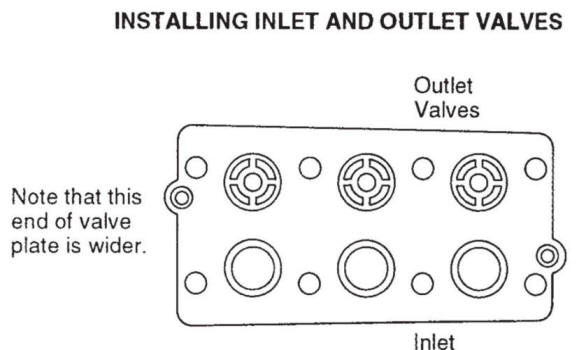
- Inlet Valves (3 lower valves): Insert the spring retainer (10) into the valve plate, then insert the spring, valve, tetra seal, valve seat with O-ring, and dampening washer (8, 7, 9, 6, 11). A flat O-ring [tetra seal] (9) goes between the plastic spring retainer and seat.
- Outlet Valves (3 upper valves): Install the three outlet valve assembly components in reverse order as the inlet valves.
3. Inspect and Replace Diaphragms (17)
- Lift a diaphragm by one edge, and turn the pump shaft until the diaphragm moves up to "top dead center". This will expose machined cross holes in the plunger shaft behind the diaphragm.
- Note: If the pump has a hollow shaft, use the shaft rotator from the Wanner® Tool Kit to turn the shaft.
- Remove the three flat-head screws (31) and O-rings (30) from the edge access holes in the diaphragm plate (18). Insert a 3/32" hex wrench into one of the holes. Turn and pull the diaphragm (17) until the front cross hole in the valve plunger spool (24) lines up and allows the hex wrench to pass through. (Do not remove the hex wrench until the new diaphragm is installed).
- Unscrew the diaphragm. Use a 5/16 in. (8 mm) open-end wrench and turn counterclockwise.
- Inspect the diaphragm carefully. A ruptured diaphragm generally indicates a system problem. Check for:
- Small puncture: Caused by sharp foreign objects or ice particles.
- Diaphragm pulled away from sides: Caused by frozen fluid or over-pressurization.
- Swollen or deteriorated elastomer: Incompatibility with the pumped fluid.
- Clean the diaphragm plate (18) and the area behind the diaphragm.
- Install a new diaphragm (or the old one if in good condition), and screw it into the valve plunger (24). Torque to 10 in-lbs (1.1 N-m).
- Remove the hex wrench.
- Repeat the procedure for the other two diaphragms.
4. Flush the Reservoir
- With the valve plate and manifold removed, the diaphragm plate (18) must be flushed.
- Drain the oil from the reservoir by removing the drain plug (60).
- Fill the reservoir with clean oil and rotate the shaft to circulate.
- Drain again. If the oil is still contaminated, repeat until clean.
5. Reinstall Valve Plate (12) and Manifold (3)
- Reinstall the valve plate (12) with the valve assemblies already installed onto the diaphragm plate (18).
- Reinstall the O-rings (4) on the rear side of the manifold. Use petroleum jelly to hold them in place.
- Reinstall the manifold (3) onto the valve plate.
- Insert all bolts (1) with washers (2) and alternately tighten opposite bolts. Torque to 15 ft-lbs (20 N-m).
- Recheck all bolts for tightness.
6. Prime the Hydraulic Cells
- With the pump horizontal, fill the reservoir with the appropriate Hydra-Oil.
- Air must be forced out of the cell behind the diaphragms by turning the shaft.
- Turn or jog the shaft until a bubble-free flow of oil comes out of each access hole in the diaphragm plate (18).
- Watch the oil level; if it gets too low during priming, air will be drawn into the pistons and you will have to start over.
- Reinstall the flat-head screw (31) and O-ring (30) for each access hole as they are primed.
D/G-03 Fluid End Service (non Kel-Cell only)
3. Inspect and Replace Diaphragms (17)
- Lift a diaphragm by one edge, and turn the pump shaft until the diaphragm moves up to "top dead center". This will expose machined cross holes in the plunger shaft behind the diaphragm.
Note: If the pump has a hollow shaft, use the shaft rotator from the Wanner®Tool Kit. - Insert a 3/32 in. hex wrench through one of the machined cross holes, to hold the diaphragm up. The proper size tool is included in the Wanner® Tool Kit. (Don't remove the tool until the new diaphragm is installed in step 6 below.)
- Unscrew the diaphragm. Use a 5/16 in. (8 mm) open-end wrench, and turn counterclockwise.
- Inspect the diaphragm carefully. A ruptured diaphragm generally indicates a pumping system problem, and replacing only the diaphragm will not solve the larger problem. Inspect the diaphragm for the following:
- Small puncture: Usually caused by a sharp foreign object in the fluid, or by an ice particle.
- Diaphragm pulled away from the sides: Usually caused by fluid being frozen in the pump, or by overpressurization of the pump.
- Diaphragm becoming stiff and losing flexibility: Usually caused by pumping a fluid that is incompatible with the diaphragm material.
- Diaphragm edge chewed away: Usually caused by over pressurizing the system.
Caution: If a diaphragm has ruptured and foreign material or water has entered the oil reservoir, the diaphragm plate (18) must be flushed.
4. Flush the Reservoir
- With the valve plate and manifold removed, the diaphragm plate (18) must be flushed.
- Drain the oil from the reservoir by removing the drain plug (60). Fill the reservoir with clean oil. Manually turn the pump shaft to circulate the oil, and drain once again.
- Refill the reservoir. If the oil appears milky, there is still contaminant in the reservoir. Repeat the flushing procedure until the oil appears clean.
5. Prime the Hydraulic Cells
- With the pump horizontal, fill the reservoir with the appropriate Hydra-Oil for the application.
- All air in the oil within the hydraulic cell (behind the diaphragms) must be forced out by turning the shaft (and thus pumping the piston). A shaft rotator is included in the Wanner® Tool Kit.
- Turn the shaft until a bubble-free flow of oil comes from behind all the diaphragms.
- Watch the oil level in the reservoir; if it gets too low during priming, air will be drawn into the pistons (inside the hydraulic end). This will cause the pump to run rough, and you will have to start over again with priming the hydraulic cells.
6. Reinstall Valve Plate (12) and Manifold (3)
- Reinstall the valve plate (12), with the valve assemblies already installed onto the diaphragm plate (18).
- Reinstall the O-rings (4) on the rear side of the manifold. Use petroleum jelly or lubricating gel to hold them in place.
- Reinstall the manifold (3) onto the valve plate.
- Insert all bolts (1), with washers (2), around the edge of the manifold, and alternately tighten opposite bolts until all are secure. Torque to 15 ft-lbs (20 N-m).
- Recheck all bolts for tightness.
Request a Quote or Call us at 908.362.9981 to speak with a sales engineer
D/G-03 Hydraulic End Service
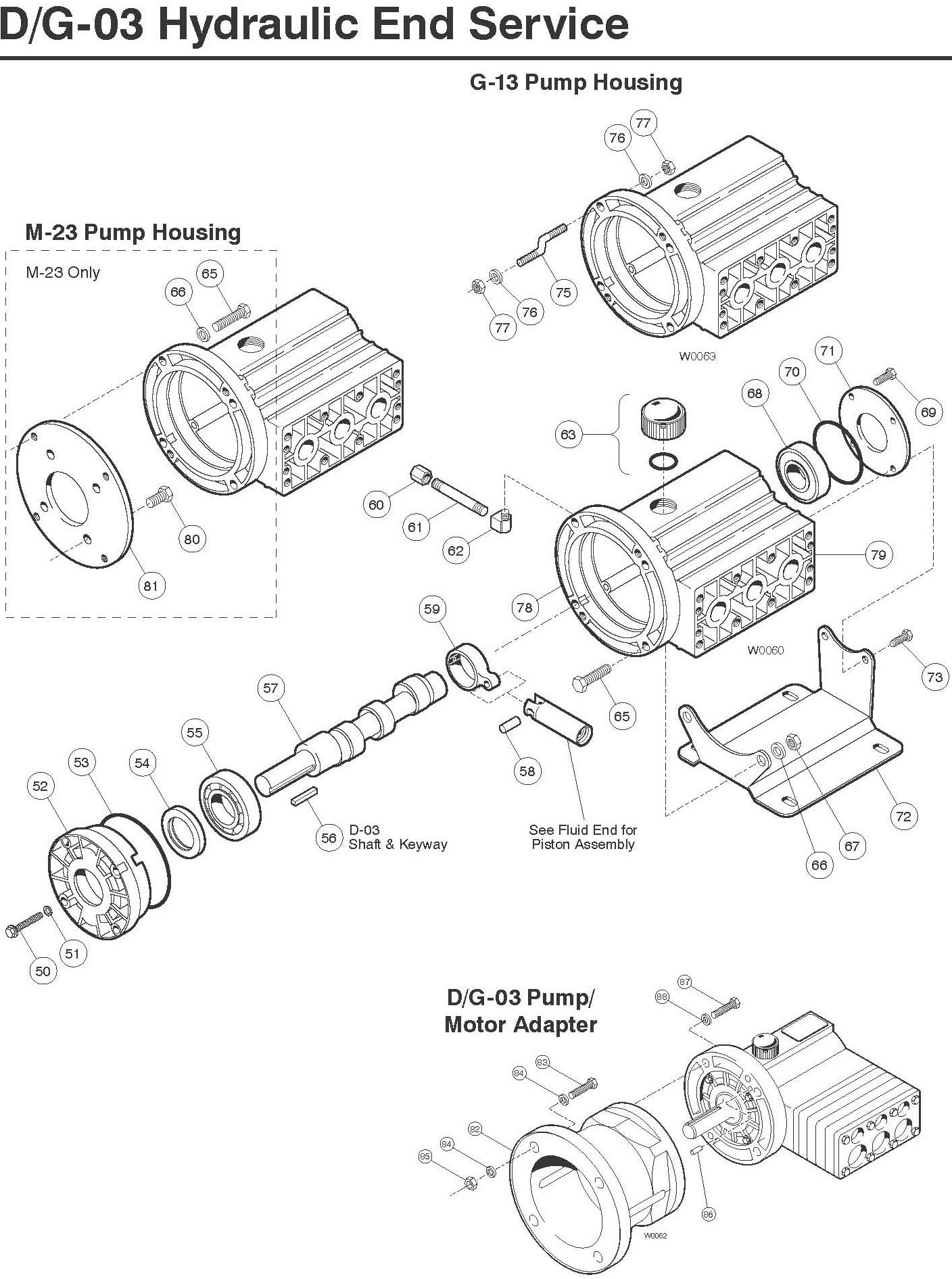
This section explains how to disassemble and inspect the hydraulic end (oil reservoir) of the pump.
Note: The numbers in parentheses are the Ref. Nos. on the illustrations in the Parts Manual.
Caution: Do not disassemble the hydraulic end unless you are a skilled mechanic. For assistance, contact Wanner® Engineering or the distributor in your area.
Internal piston components (21-27) can be serviced without removing the motor or crankshaft. The motor and crankshaft must be removed to service the connecting rod (59), piston housing (20), crankshaft (57), front bearing (68), back bearing (55), or seal (54).
To Service Pistons Without Removing Motor or Crankshaft
1. Disassemble Pistons
With the manifold, valve plate, diaphragm plate, and diaphragm removed, and the oil drained from the pump (see the Fluid End Service Section):
- Remove the snap ring (27) from one of the pistons, using a standard snap-ring pliers.
- Pull out the valve plunger (24). This also removes the washer (26) and spring (25).
- Insert a hook through the center hole of the valve cylinder (22), and pull the cylinder out of the piston. Be careful not to damage the piston.
- Inspect all parts, and replace the O-ring and any other parts that are worn or damaged.
- Repeat the procedure for the other two pistons.
2. Reassemble Pistons
- Install the O-ring (23) onto the valve cylinder (22).
- Insert the valve cylinder into the piston (21).
- Insert the spring (25), valve plunger (24), and washer (26) into the valve cylinder.
- Install the snap ring (27) into the groove in the piston.
- Repeat the procedure for the other two pistons.
To Service the Rest of the Hydraulic End
1. Separate Motor from Pump
- M-03: Remove the four bolts (65) and washers (66) that secure the pump and motor together.
M-23: Remove the four bolts (65) and washers (66) that secure the pump and adapter plate (81) together.
G-13: Remove the four nuts (77) and washers (76) from the motor side of the offset stud (75). - M-03, M-23: Install two of the bolts into the threaded holes in the rear of the pump housing.
G-13: Install two M10 x 1.5 x 40 mm (65) or longer bolts into the threaded holes in the rear flange of the pump housing. - Alternately turn the bolts clockwise until the pump and motor separate.
2. Reassemble Motor to Pump
- Thoroughly clean the motor shaft and the hollow pump shaft. Remove the tape from the key and keyway.
- Apply a liberal amount of Loctite® Nickel Anti-Seize No. 77164 to the pump shaft.
- Install the shaft key (56) into the keyway.
- Slide the motor shaft into the hollow pump shaft.
Caution:
Use a screwdriver to move the shaft key back in the motor shaft keyway as the motor and pump are drawn together.
D/G-03 Hydraulic End Service (Continued)
To Service the Remainder of the Hydraulic End
1. Remove Pump Housing
- Remove the manifold, valve plate, and diaphragms, as outlined in the Fluid End Service Section.
- Drain the oil from the pump housing by removing the drain plug (60).
- Stand the pump on end, with the drive shaft up.
- Remove the bolts (50) that secure the back cover (52) to the housing (78). Use a 3/8 in. socket wrench (10-mm on M-03/G-03 and G-13). Save the O-rings (51).
- Remove the cover and the cover O-ring (53).
- Remove the crankshaft (57) by pulling it through the connecting rods (59).
2. Remove and Replace Pistons
- To remove the pistons (20), first remove the connecting rod (59) and pin (58) by pressing the pin through the connecting rod.
- Reverse the process to reinstall the pistons.
- Refer to Steps 5 and 6 below to replace the diaphragm and reassemble the pump.
3. Replace Shaft Seal
Note: Inspect the shaft seal (54) before continuing. If it looks damaged in any way, replace it.
- Press the back bearing (55) and seal (54) out of the back cover (52). Discard the seal.
- Apply a coating of Loctite® High-Performance Pipe Sealant with PTFE, or a comparable product, to the outer surface of a new seal and the inside surface of the opening in the back cover (52) where the seal will rest.
- Press the new seal into the back cover.
- Inspect the bearing (55). If pitted or damaged, replace it.
- Apply a coating of Loctite Rc/609 Retaining Compound or comparable product to the outer surface of the bearing. Press the bearing into the back cover until it rests on the shoulder. The shield on the bearing must face away from the back cover.
4. Reassemble Housing and Back Cover
- Stand the pump on end.
- With the pistons and connecting rods in place, reinstall the crankshaft by threading it through the connecting rods.
- Reinstall the back cover (52), cover O-ring (53), and bolts (with their O-rings).
5. Reassemble Pump
Reassemble the pump as outlined in the Fluid End Service Section, following the specific steps for your version (Kel-Cell or non Kel-Cell).
D/G-03 Troubleshooting
Cavitation
Inadequate fluid supply because:
- Inlet line collapsed or clogged
- Clogged line strainer
- Inlet line too small or too long
- Air leak in inlet line
- Worn or damaged inlet hose
- Suction line too long
- Too many valves and elbows in inlet line
- Fluid too hot for inlet suction piping system
- Air entrained in fluid piping system
- Aeration and turbulence in supply tank
- Inlet vacuum too high (refer to "Inlet Calculations", page 3)
- Excessive pump valve noise
- Premature failure of spring or retainer
- Volume or pressure drop
- Rough-running pump
- Premature failure of diaphragms
Pump Runs Rough
- Worn pump valves
- Air lock in outlet system
- Oil level low
- Wrong weight of oil for cold operating temperatures (change to lighter weight)
- Cavitation
- Air in suction line
- Restriction in inlet/suction line
- Hydraulic cells not primed after changing diaphragm
- Foreign material in inlet or outlet valve
- Damaged diaphragm
- Fatigued or broken valve spring
Premature Failure of Diaphragm
- Frozen pump
- Puncture by a foreign object
- Elastomer incompatible with fluid being pumped
- Pump running too fast
- Excess pressure
- Cavitation
Drop in Volume or Pressure
A drop in volume or pressure can be caused by one or more of the following:
- Air leak in suction piping
- Clogged suction line or suction strainer
- Suction line inlet above fluid level in tank
- Inadequate fluid supply
- Pump not operating at proper RPM
- Relief valve bypass gate open
- Foreign material in inlet or outlet valve
- Loss of oil
- Worn pump valve parts
- Foreign material in inlet or outlet valve
- Manifold from over pressurized system
- O-rings forced out of their grooves from over pressurization
- Air leak in suction line strainer or gasket
- Cracked suction hose
- Empty supply tank
- Excessive aeration and turbulence in supply tank
- Cavitation
- Abrasives in the fluid
- Valve incompatible with corrosives in the fluid
- Pump running too fast
- Worn and slipping drive belt(s)
- Worn spray nozzle(s)
Water (or Process Fluid) in Oil Reservoir
- Condensation
- Ruptured diaphragm
- Hydraulic cell not properly primed after diaphragm replacement
- Frozen pump
Strong Water (or Process Fluid) Pulsations
- Foreign object lodged in pump valve
- Loss of prime in hydraulic cell because of low oil level
- Air in suction line
- Valve spring (8) broken
- Cavitation
- Aeration or turbulence in supply tank
Valve Wear
- Normal wear from high-speed operation
- Cavitation
- Abrasives in the fluid
- Valve incompatible with corrosives in the fluid
- Pump running too fast
Loss of Oil
- External seepage
- Rupture of diaphragm
- Frozen pump
- Worn shaft seal
- Oil drain piping or fill cap loose
- Valve plate and manifold bolts loose
- Pump housing porosity
Premature Failure of Valve Spring or Retainer
- Cavitation
- Foreign object in the pump
- Pump running too fast
- Spring/retainer material incompatible with fluid being pumped
- Excessive inlet pressure
 Request a Quote
or
Call us at 908.362.9981
Request a Quote
or
Call us at 908.362.9981
| Ref. | Part Number | Description | Qty | ||||||||||||||||||||||||||||||
|---|---|---|---|---|---|---|---|---|---|---|---|---|---|---|---|---|---|---|---|---|---|---|---|---|---|---|---|---|---|---|---|---|---|
| 1 |
|
||||||||||||||||||||||||||||||||
| 2 |
|
||||||||||||||||||||||||||||||||
| 3 |
|
||||||||||||||||||||||||||||||||
| 4 |
|
||||||||||||||||||||||||||||||||
| 5 |
|
||||||||||||||||||||||||||||||||
| 6 |
|
||||||||||||||||||||||||||||||||
| 7 |
|
||||||||||||||||||||||||||||||||
| 8 |
|
||||||||||||||||||||||||||||||||
| 9 |
|
||||||||||||||||||||||||||||||||
| 10 |
|
||||||||||||||||||||||||||||||||
| 11 |
|
||||||||||||||||||||||||||||||||
| 12 |
|
||||||||||||||||||||||||||||||||
| 14 |
|
||||||||||||||||||||||||||||||||
| 16 |
|
||||||||||||||||||||||||||||||||
| 17 |
|
||||||||||||||||||||||||||||||||
| 18 |
|
||||||||||||||||||||||||||||||||
| 19 |
|
||||||||||||||||||||||||||||||||
| 20 |
|
||||||||||||||||||||||||||||||||
| 21 |
|
||||||||||||||||||||||||||||||||
| 22 |
|
||||||||||||||||||||||||||||||||
| 23 |
|
||||||||||||||||||||||||||||||||
| 24 |
|
||||||||||||||||||||||||||||||||
| Ref. | Part Number | Description | Qty | |||||||||
|---|---|---|---|---|---|---|---|---|---|---|---|---|
| 25 |
|
|||||||||||
| 26 |
|
|||||||||||
| 27 |
|
|||||||||||
| 28 |
|
|||||||||||
| 29 |
|
|||||||||||
| 30 |
|
|||||||||||
| 31 |
|
|||||||||||
| 73 |
|
|||||||||||
| 79 |
|
|||||||||||
| 82 |
|
|||||||||||
| 83 |
|
|||||||||||