
Following is the digital version of the model D10 Hydra-Cell Pro Pump IOM and parts manual file D10-991-2400-Rev-D.pdf; use the navigation bar below to jump to the applicable section.

D/G10 Specifications

Maximum Flow Rate 8.8 gpm (33.4 l/min)
Maximum Pressure Metallic: 1500 psi (103 bar)
Non-Metallic: 350 psi (24 bar)
Flow Capacities @ 1000 psi (69 bar)
Modelrpmgpml/min
D/G10-X14508.130.6
D/G10-E17508.833.4
Flow Capacities @ 1500 psi (103 bar)
Modelrpmgpml/min
D/G10-X7904.2615.1
D/G10-E7903.8714.7
Delivery @ 1500 psi (103 bar)
Modelgal/revliters/rev
D/G10-X0.00540.0205
D/G10-E0.00490.0186
Delivery @ 1000 psi (69 bar)
Modelgal/revliters/rev
D/G10-X0.00560.0211
D/G10-E0.00510.0191
Maximum Discharge Pressure Metallic Heads:
1000 psi (69 bar) @ 1450 rpm (D/G10-X)
1000 psi (69 bar) @ 1750 rpm (D/G10-E)
1500 psi (103 bar) @ 790 rpm (D/G10-X)

Non-Metallic Heads:
250 psi (17 bar) Polypropylene
350 psi (24 bar) PVDF
Max Inlet Pressure Metallic: 250 psi (17 bar)
Non-Metallic: 50 psi (3.5 bar)
Fluid Temperature Metallic Heads: 250°F (121°C) – consult factory for temperatures above 160°F (71°C)
Non-Metallic Heads: Polypropylene: 120°F (49°C); PVDF: 140°F (60°C) – consult factory for temperatures above 120°F (49°C)
Maximum Solids Size 500 microns
Inlet Port D10: 1 inch NPT | G10: 1 inch BSPT
Discharge Port D10: 3/4 inch NPT | G10: 3/4 inch BSPT
Shaft Diameter 7/8 inch (22.2 mm)
Shaft Rotation Reverse (bi-directional)
Bearings Tapered roller bearings
Oil Capacity 1.1 US quarts (1.04 liters)
Weight Metallic Heads: 48 lbs (21.8 kg)
Non-metallic Heads: 35 lbs (15.9 kg)

Calculating Required Horsepower (kW) *

US Units:
[(15 x rpm) / 63,000] + [(gpm x psi) / 1,460] = electric motor HP*

Metric Units:
[(15 x rpm) / 84,428] + [(l/min x bar) / 511] = electric motor kW*
* rpm equals pump shaft rpm. HP/kW is required application power. When using a variable frequency drive (VFD) calculate the hp or kW at minimum and maximum pump speed to ensure the correct hp or kW motor is selected. Note that motor manufacturers typically de-rate the service factor to 1.0 when operating with a VFD.

D/G10 Installation

Safety Precautions

General Remarks

These safety / installation instructions contain fundamental information and precautionary notes and must be kept available to all associated with the operation of the pump. Please read them thoroughly prior to installation, electrical connection and commissioning of the unit. It is imperative that all other operating instructions relating to the components of individual units are followed.

These safety / installation instructions do not take local regulations into account. The operator must ensure that such regulations are observed by all, including the personnel carrying out the installation.

Each pump must be labeled by the end user to warn of any hazards that the system process may produce; e.g. corrosive chemicals or hot process etc.

All personnel involved in the operation, maintenance, inspection and installation of the pump must be fully qualified to carry out the work. The personnel’s responsibilities, competence and supervision must be clearly defined by the operator. To the extent that if the personnel in question is not already in possession of the requisite know-how, appropriate training and instruction must be provided. In addition, the operator is responsible for ensuring that the contents of the operating instructions are fully understood by all the responsible personnel.

When installing a Hydra-Cell pump in conjunction with a motor or motor and frequency controller the relevant manuals must be referred to for electromagnetic compatibility. The installation should conform to EN 61800 and EN 60204 as applicable.

All safety instructions in this manual and all relevant local health and safety regulations must be followed.

Attention must be paid to the weight of the pump before attempting to lift either manually or selecting appropriate lifting equipment.

D/G10 Installation (Continued)

Location

Locate the pump as close to the supply source as possible. Install it in a lighted clean space where it will be easy to inspect and maintain. Allow room for checking the oil level, changing the oil, and removing the pump head (manifold, valve plate and related items).

Mounting

The pump shaft can rotate in either direction. To prevent vibration, mount the pump and motor securely on a level rigid base.

  • Belt-Drive Systems: Align the sheaves accurately; poor alignment wastes horsepower and shortens the belt and bearing life. Make sure the belts are properly tightened, as specified by the belt manufacturer.
  • Direct-Drive Systems: Align the shafts accurately. Unless otherwise specified by the coupling manufacturer, maximum parallel misalignment should not exceed 0.015 in. (0.4 mm) and angular misalignment should be held to 1° maximum.
  • Close-Coupled Systems: Coat the motor shaft liberally with anti-seize.

The pump, motor and related components must be adequately grounded.

Equipment Precautions

Adequate Fluid Supply

To avoid cavitation and premature pump failure, be sure that the pump will have an adequate fluid supply and that the inlet line will not be obstructed. See “Inlet Piping”.

Positive Displacement

This is a positive-displacement pump. To avoid severe system damage if the discharge line ever becomes blocked, install a relief valve downstream from the pump. A suitable and calibrated pressure gauge should be installed in the discharge line close to the pump head.

Safety Guards

Install adequate safety guards over all pulleys, belts, and couplings. Follow all codes and regulations regarding installation and operation of the pumping system.

Shut-Off Valves

Never install shut-off valves between the pump and discharge pressure regulator, or in the regulator bypass line.

Freezing Conditions and Temperature

Protect the pump from freezing. The pump body will become hot during operation even if the liquid being pumped is cold.

Consult the Factory for the Following:

  • Extreme temperature applications – above 160° F (71°C) or below 40° F (4.4°C).
  • Pressure feeding of pumps.
  • Viscous or abrasive fluid applications.
  • Chemical compatibility problems.
  • Hot ambient temperatures – above 110° F (43°C).
  • Conditions where pump oil may exceed 200° F (93°C).

D/G10 Installation (Continued)

Inlet Piping (Suction Feed)

CAUTION: When pumping at temperatures above 160° F (71°C), attention must be paid to the vapor pressure curve of the liquid. A pressure-feed system may be required.
  • Do not supply more than one pump from the same inlet line.
  • With PTFE diaphragms, the inlet must be flooded.
  • Install drain cocks at any low points of the suction line, to permit draining in freezing conditions.
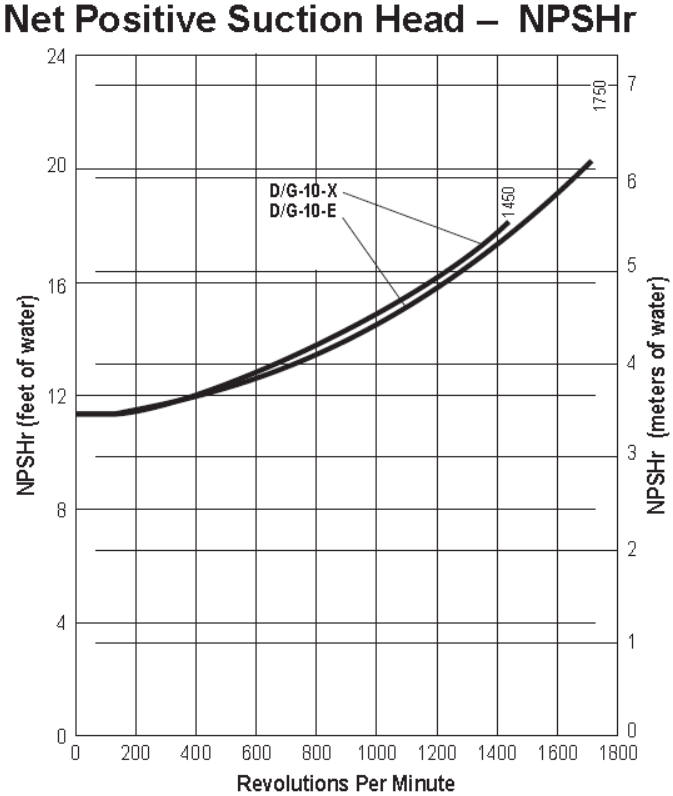
  • Provide for permanent or temporary installation of a vacuum gauge to monitor the inlet suction. To maintain maximum flow, ensure the system NPSHa exceeds the NPSHr of the pump.

Supply Tank

Use a supply tank that is large enough to provide time for any trapped air in the fluid to escape. The tank size should be at least twice the maximum pump flow rate.

  • Isolate the pump and motor stand from the supply tank, and support them separately.
  • Install a separate inlet line from the supply tank to each pump.
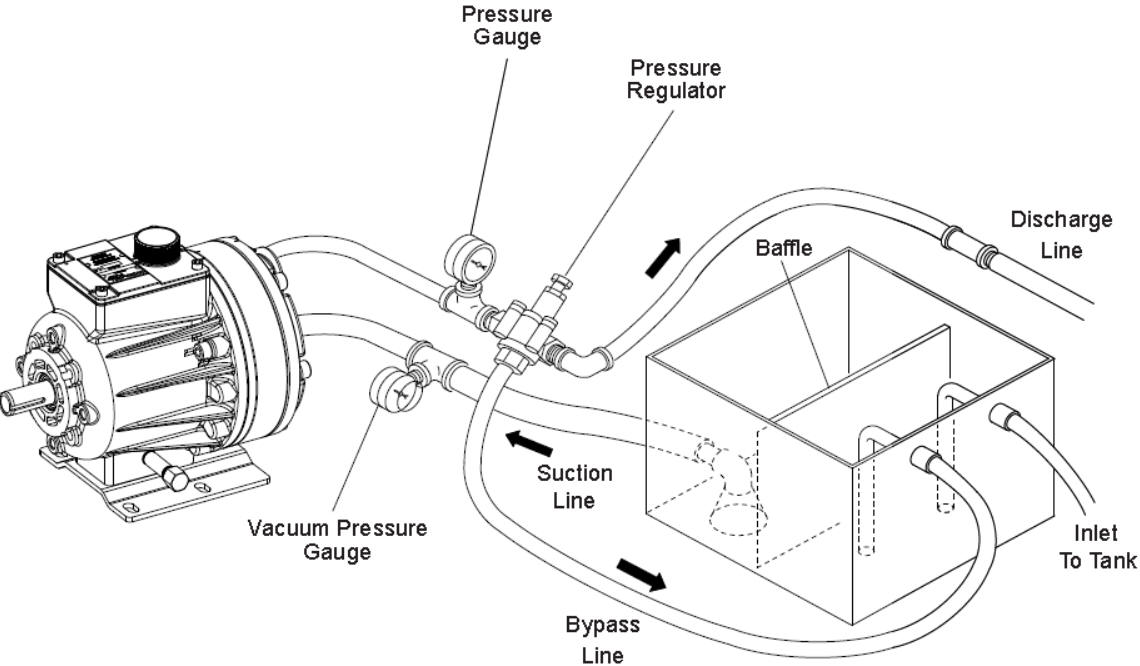
  • Install the inlet and bypass lines so they empty into the supply tank below the lowest water level, on the opposite side of the baffle from the pump suction line.
  • Do not use a line strainer or filter in the suction line unless regular maintenance is assured. If used, it should have a free-flow area of at least three times the area of the inlet.
  • Install a completely submerged baffle plate to separate incoming and outgoing liquids.
  • Install a vortex breaker and a cover over the supply tank.

Model D10 Hydra-Cell Pro Pump Installation

Hose and Routing

Size the suction line at least one size larger than the pump inlet, ensuring velocity does not exceed 1-3 ft/sec (0.3 to 0.9 m/s).

Velocity Formulas:
Metric (m/sec) = 21.2 x LPM / Pipe ID²
US (ft/sec) = 0.408 x GPM / Pipe ID²
  • Keep the suction line as short and direct as possible (maximum 1m / 3 feet recommended).
  • Use flexible hose and/or expansion joints to absorb vibration.
  • Keep the suction line level. Avoid high points that collect vapor unless vented.
  • Do not use 90° elbows. Use 45° elbows or sweeping curves to reduce turbulence.
  • If a block valve is used, ensure it is fully opened and has a diameter at least equal to the inlet plumbing ID.

D/G10 Installation (Continued)

Inlet Piping (Pressure Feed)

Provide for permanent or temporary installation of a vacuum/pressure gauge to monitor the inlet vacuum or pressure.

  • Pressure at the pump inlet should not exceed 250 psi (17 bar); if it could get higher, install an inlet pressure reducing regulator.
  • Do not supply more than one pump from the same inlet line.

Inlet Calculations

Acceleration Head

Use the following formula to calculate acceleration head losses. Subtract this figure from the NPSHa, and compare the result to the NPSHr of the Hydra-Cell pump.

Ha = (L x V x N x C) ÷ (K x G)
Variable Description
HaAcceleration head (ft of liquid)
LActual length of suction line (ft) — not equivalent length
VVelocity of liquid in suction line (ft/sec) [V = 0.408 x GPM / Pipe ID²]
NRPM of crankshaft
CConstant determined by type of pump — Use 0.066 for D/G10 pumps
KConstant to compensate for compressibility of fluid:
• 1.4 for de-aerated or hot water
• 1.5 for most liquids
• 2.5 for hydrocarbons with high compressibility
GGravitational constant (32.2 ft/sec²)

Friction Losses

When following recommendations for minimum hose I.D. and maximum length, frictional losses in suction piping are typically negligible (Hf = 0) for water-like fluids.

When pumping viscous fluids (oils, sealants, adhesives, etc.), frictional losses (Hf) may become significant, decreasing available NPSH (NPSHa) and causing cavitation.

Note: Changes in suction-line diameter have the greatest impact. A 25% increase in diameter cuts losses by more than 2x; a 50% increase cuts losses by a factor of 5x.

Minimizing Acceleration Head and Frictional Losses

  • Keep inlet lines less than 1 m (3 ft) long.
  • Use inlet hose at least one size larger than the pump inlet port.
  • Use flexible, non-collapsible suction hose and/or expansion joints to absorb vibrations.
  • Minimize fittings (elbows, valves, tees, etc.).
  • Use a suction stabilizer on the inlet.

D/G10 Installation (Continued)

Net Positive Suction Head (NPSH)

NPSHa must be equal to or greater than NPSHr. If not, the pressure in the pump inlet will be lower than the vapor pressure of the fluid—and cavitation will occur.

Calculating the NPSHa

Use the following formula to calculate the NPSHa:

NPSHa = Pt + Hz - Hf - Ha - Pvp
PtAtmospheric pressure
HzVertical distance from surface liquid to pump center line (Hz is negative if liquid is below center line)
HfFriction losses in suction piping
HaAcceleration head at pump suction
PvpAbsolute vapor pressure of liquid at pumping temperature
Model D10 Hydra-Cell Pro Pump NPSHr
Notes:
In good practice, NPSHa should be 2 ft (0.6 m) greater than NPSHr. All values must be expressed in feet of liquid.
 

Atmospheric Pressure at Various Altitudes

Altitude (ft) Pressure (ft of H2O) Altitude (ft) Pressure (ft of H2O)
033.9150032.1
50033.3200031.5
100032.8500028.2

Discharge Piping

Note: Consult the Factory before manifolding two or more pumps together.

Hose and Routing

  • Use the shortest, most-direct route for the discharge line.
  • Select pipe or hose with a working pressure rating of at least 1.5 times the maximum system pressure.
  • Use approximately 6 ft (1.8 m) of flexible hose between the pump and rigid piping to absorb vibration.
  • Size the discharge line so fluid velocity does not exceed 8-10 ft/sec (2-3 m/sec).
Discharge Velocity Formulas:
Metric (m/sec) = 21.2 x LPM / Pipe ID²
US (ft/sec) = 0.408 x GPM / Pipe ID²

Pressure Regulation

  • Install a pressure regulator or unloader in the discharge line. Bypass pressure must not exceed the pump's pressure limit.
  • Locate the regulator as close to the pump as possible and ahead of any other valves.
  • Adjust the regulator to no more than 10% over the maximum working pressure of the system.
  • Route the bypass line to the supply tank, not to the suction line.
  • If running with the discharge closed for long periods, install a thermal protector in the bypass line.
CAUTION: Never install shutoff valves in the bypass line or between the pump and pressure regulator or relief valve.

Provide for permanent or temporary installation of a pressure gauge to monitor discharge pressure at the pump. For additional protection, install a safety relief valve downstream from the pressure regulator.

D/G10 Installation (Continued)

Before Initial Start-Up

Before you start the pump, perform the following final checks:

  • Valves: Ensure all shut-off valves are open and the pump has an adequate fluid supply.
  • Connections: Verify that all plumbing connections are tight.
  • Oil Level: Check that the oil level is correct, approximately 1/4 in. (6 mm) from the bottom of the fill port.
  • Relief Valve: Ensure the relief valve on the pump outlet is adjusted so the pump starts under minimum pressure.
  • Drive System: Confirm all pulleys and belts are properly aligned and tensioned to specification.
  • Safety: Verify all pulleys and belts have adequate safety guards.
  • Compatibility: Ensure the pump materials of construction are compatible with the process liquid.

Initial Start-Up Procedure

  1. Power: Turn on power to the pump motor.
  2. Monitor Inlet: Check inlet pressure or vacuum. To maintain maximum flow, inlet vacuum must not exceed 7 in. Hg at 70° F (180 mm Hg at 21°C). Inlet pressure must not exceed 250 psi (17 bar).
  3. Inspection: Listen for erratic noise and look for unsteady flow.
  4. Priming: If the system has an airlock and fails to prime:
    • Turn off power.
    • Remove the pressure gauge or plug from the tee fitting at the pump outlet.
      Note: Fluid will come out when the pump is started. Use high-pressure-rated hose and fittings to pipe this to a catch basin. Take all safety precautions for fluid handling.
    • Jog the system on and off until the fluid is air-free.
    • Turn off power, remove temporary plumbing, and reinstall the gauge or plug.
  5. Pressure Adjustment: Adjust the discharge pressure regulator to the desired operating and bypass pressures. Do not exceed the maximum pressure rating of the pump.
  6. Safety Relief Setting: Set the safety relief valve at 100 psi (7 bar) higher than the desired operating pressure. To verify, adjust the regulator upward until the relief valve opens.
  7. System Calibration: Reset the discharge pressure regulator to the desired system pressure.
  8. Return Line: Provide a return line from the relief valve back to the supply tank.

D/G10 Maintenance

Note: The numbers in parentheses are the Reference Numbers on the exploded view illustrations found in the Parts Section of this manual.

Daily Maintenance

Check oil level and condition of oil. The oil is at the correct level when it is 1/4 in. (6 mm) from the bottom of the fill port.

Use the appropriate Hydra-Oil for the application (contact Wanner Engineering if in doubt).

CAUTION: If you are losing oil but don’t see any external leakage, or if the oil becomes discolored/contaminated, one of the diaphragms (43) may be damaged. Refer to the Fluid-End Service Section. Do not operate the pump with a damaged diaphragm.
CAUTION: Do not leave contaminated oil in the pump housing or leave the housing empty. Remove contaminated oil as soon as discovered, and replace it with clean oil.

Periodic Maintenance

Change the oil after the first 100 hours of operation, and then according to the guidelines below.

Hours Between Oil Changes @ Various Process Fluid Temperatures

Pressure RPM <90°F (32°C) <139°F (60°C) <180°F (82°C)
Metallic Pump Head
<650 psi (45 bar) <1200 6,000 4,500 3,000
<1800 4,000 3,000 2,000
<1000 psi (69 bar) <1200 4,000 3,000 2,000
<1800 2,000 1,500 1,000
Non-Metallic Pump Head
<250 psi (17 bar) <1200 4,000 3,000
<1800 2,000 1,500

Note: Minimum oil viscosity for proper hydraulic end lubrication is 16-20 cST (80-100 SSU).

Note: Use of an oil cooler is recommended when process fluid and/or hydraulic end oil exceeds 180°F (82°C).

When changing, remove the drain pipe cap (10) at the bottom of the pump so all oil and accumulated sediment will drain out.

CAUTION: Do not turn the drive shaft while the oil reservoir is empty.

Shutdown Procedure During Freezing Temperatures

Take all safety precautions for fluid handling. Provide catch basins and use compatible antifreeze.

  1. Adjust discharge pressure regulating valve to minimum pressure. Stop pump.
  2. Drain supply tank, open system draincocks, and remove manifold pipe cap (10) to collect drainage.
  3. Close draincocks and replace manifold plug.
  4. Fill supply tank with enough antifreeze to fill system piping and pump.
  5. Start pump and run until system is filled with antifreeze.
  6. Stop pump once antifreeze flows from return line. Reconnect return line to supply tank.
  7. Pro-Tip: Change the hydraulic end oil before extended storage to remove condensation/sediment.
D/G10 Fluid End Service

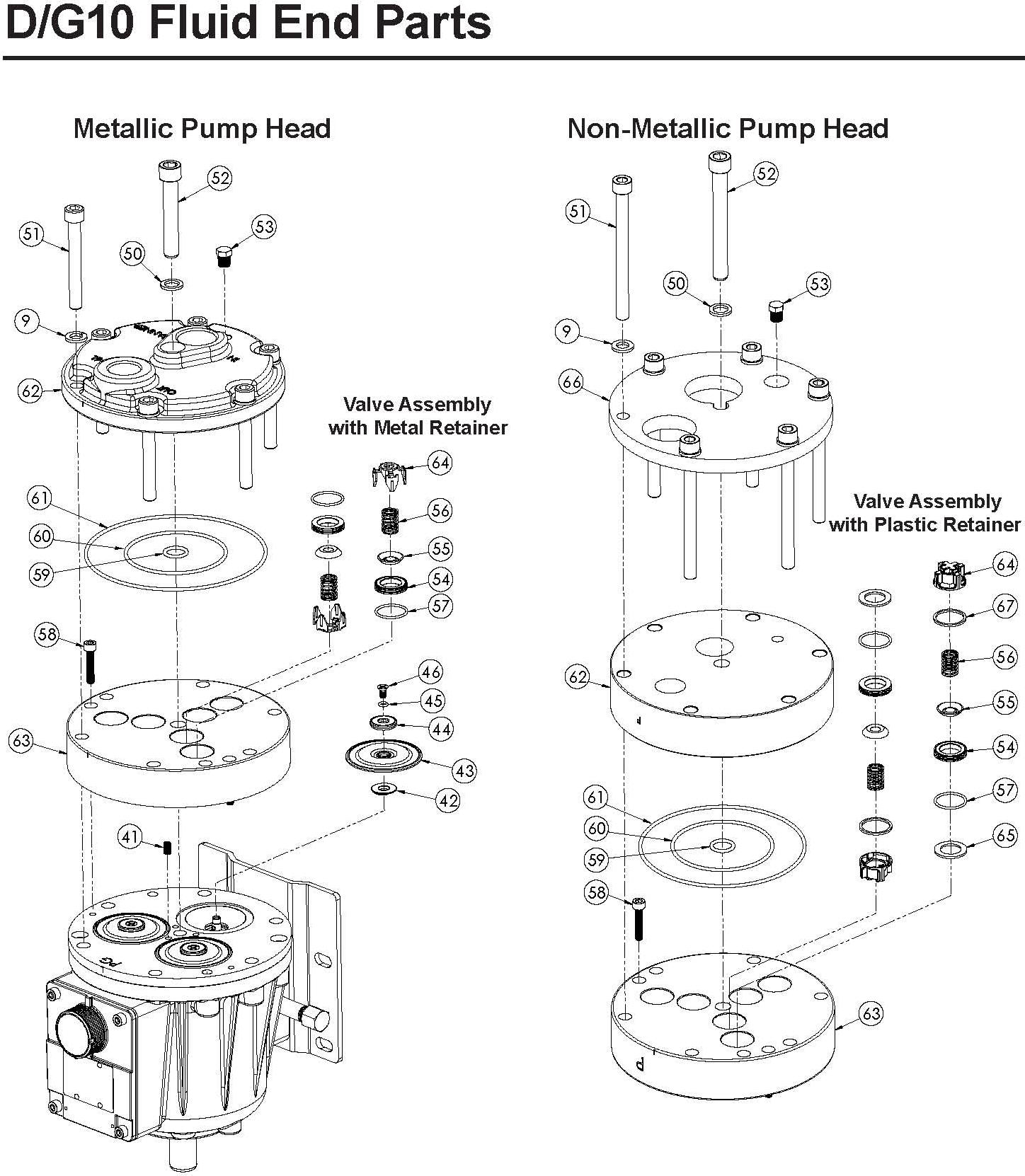
Note: The reference numbers in parentheses are shown in the Fluid End Parts Section.

This section explains how to disassemble and inspect all easily-serviceable parts of the pump fluid end.

CAUTION: Disassembly of the fluid end of the pump should be performed only by a qualified technician. For assistance, contact Wanner Engineering or your local distributor.

Note: Wanner strongly recommends the use of the Wanner Tool Kit (P/N A03-175-1101) when repairing or servicing the pump.

1. Remove Manifold (62), Valve Plate (63)

  1. Remove six bolts (51) and six washers (9) around the manifold (62). Do not remove bolt (3) or bolt (8) installed through the back of the cylinder housing (40).
  2. Use a 3/8-in. (10-mm) hex Allen wrench to remove the center bolt (52) and washer (50).
  3. CAUTION: Do not turn the pump drive shaft while the manifold and valve plate are off the pump, except when removing diaphragms or repriming hydraulic cells.
  4. Remove manifold (62) and support plate (66) [Non-metallic models only]. The valve plate (63) will remain on the cylinder housing (40).
  5. Inspect manifold (62) for warping or wear. If wear is excessive, replace the manifold. To check for warping, remove O-rings and place a straightedge across the surface.

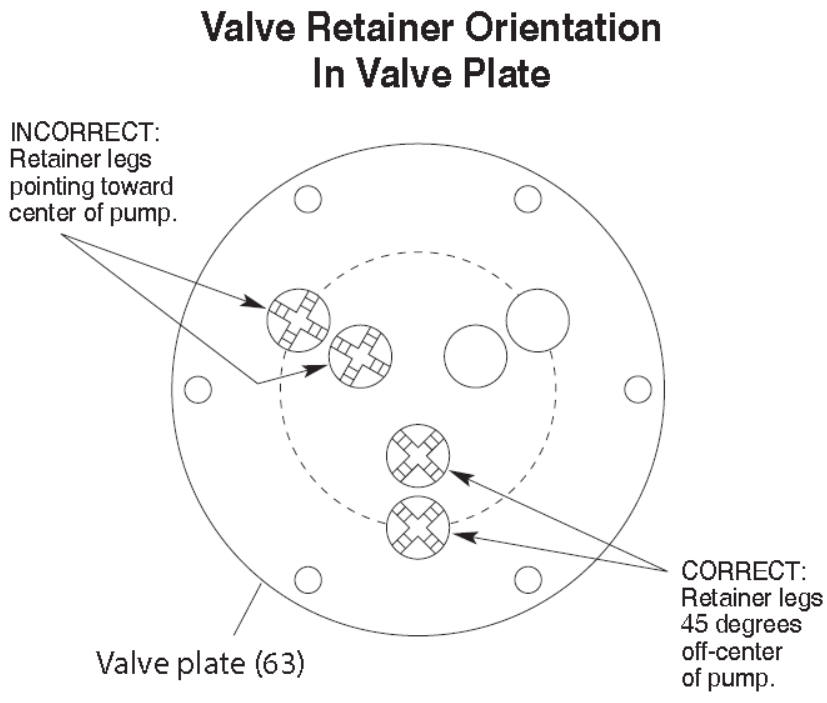
Model D10 Hydra-Cell Pro Pump Valve Retainer Orientation

2. Inspect Valves (54-57, 64, 65, 67)

The three inlet and three outlet valve assemblies are identical but face opposite directions. Inspect each as follows:

  1. Check spring retainer (64); replace if worn. Non-metallic heads include a plastic dampening washer (65) at the bottom of each seat—inspect for cracks.
  2. Check valve spring (56). Replace if shorter than a new spring. (Do not stretch).
  3. Check valve (55). Replace if worn excessively.
  4. Remove valve seat (54) and O-ring (57) using the seat puller from the tool kit. Inspect seat and install a new O-ring.
  5. Reinstall Valve Assemblies:
    • Clean and lubricate ports with lubricating gel.
    • Inlet Valves (3 center valves): Insert retainer (64), then spring (56), valve (55), and seat (54). (Include Tetra seal 67 for plastic retainers).
    • Outlet Valves (3 outer valves): Insert dampening washer (65), then seat (54), valve (55), spring (56), and retainer (65). Position metal retainers so a leg does not point toward the pump center.

D/G10 Fluid End Service (Continued)

3. Inspect and Replace Diaphragms (43)

If diaphragm service is required, remove the two socket-head cap screws (58) securing the valve plate (63) to the cylinder housing (40). Inspect the valve plate for warping using a straightedge.

  1. Lift diaphragm (43) by one edge and turn the pump shaft (using the shaft rotator from the tool kit) until the diaphragm pulls up, exposing the machined cross-holes in the plunger shaft.
  2. Insert the plunger holder through a cross-hole to hold the diaphragm in the "up" position. Do not remove until the new diaphragm is installed.
  3. Remove the screw (46), O-ring (45), and follower (44) from the center.
  4. Diaphragm Inspection: Inspect the diaphragm (43) carefully. A damaged diaphragm often indicates a systemic problem. Look for:
    • Puncture: Caused by sharp foreign objects in fluid.
    • Pulled Edges: Caused by freezing or over-pressurization.
    • Stiffness/Brittleness: Caused by chemical incompatibility.
    • Chewed Edges: Caused by system over-pressurization.
  5. Inspect plunger (42) for rough surfaces. Smooth edges with emery cloth if necessary, but do not remove the plunger from the shaft.
CAUTION: If a diaphragm has ruptured and water or foreign material has entered the oil reservoir, do not operate the pump. Flush the reservoir completely as outlined in Section 4.
  1. Install the new diaphragm (43) with the ridge side facing out.
  2. Clean screw (46), apply medium-strength thread locker, and reinstall with the follower (44) and a new O-ring (45).
  3. Torque Setting: Tighten the center screw to 18 in-lbs (2.0 N-m).
  4. Repeat the procedure for the remaining two diaphragms.

4. Flush Contaminant from Hydraulic End

Perform this procedure only if a diaphragm has ruptured.

  1. Remove the brass drain cap (10) and drain all oil and contaminants.
  2. Fill the reservoir with a compatible solvent. Manually turn the pump shaft to circulate and then drain.
    CAUTION: For EPDM diaphragms or food-grade oil systems, do not use kerosene or solvents. Flush only with the same lubricant used in the reservoir.
  3. Repeat the flushing procedure.
  4. Fill with fresh oil, circulate manually, and drain.
  5. Refill with fresh oil. If the oil appears "milky," contaminants remain. Repeat flushing until the oil is clear.

D/G10 Fluid End Service (Continued)

5. Priming Hydraulic Cells

Note: Priming requires pressure to be applied to the diaphragms to force air out of the hydraulic cells. Choose the method most suitable for your system setup.

Method 1 (System head pressure less than 2 psi)

  1. Install valve plate (63) without outlet valves onto the cylinder housing (40).
  2. Fill reservoir with correct Hydra-oil to the fill port.
  3. Using a blunt pointer (like the eraser end of a pencil), reach through each outlet valve port and push the diaphragm (43) backwards. Watch for air bubbles at the oil fill port. Turn shaft 1/2 turn.
  4. Repeat until no more bubbles escape and the oil level drops about 1 inch (25 mm). Replace oil fill cap (5).
  5. Install outlet valve assemblies and the manifold (62) to complete installation.


Alternate Method 1 (System head pressure less than 2 psi)

  1.  With pump horizontal, and the fluid-end head removed, fill reservoir with correct Hydra-oil to fill port.
  2. Have catch basin for oil that leaks from behind diaphragms when priming. Catch oil and dispose of properly. Do not reuse oil.
  3. All air in oil within hydraulic piston behind diaphragms (43) must be forced out by turning shaft (and pumping piston). A shaft rotator is included in the Wanner Tool Kit. Keep pressure on diaphragms while turning shaft until bubblefree flow of oil comes from behind all diaphragms. Maintain
    oil level in reservoir. Do not allow oil level to be lower than reservoir.
  4.  Before oil runs out past diaphragms (43), quickly attach loaded valve plate (63) with socket head screws (58). Do not tighten screws completely. Leave gap between valve plate and the cylinder housing (40). Turn shaft 2-3 turns to finish forcing out air behind diaphragms. Hydraulic cells
    are now primed. Finish tightening valve plate with two socket head screws (51) and add pump manifold (62).
  5. Wipe excess oil from around pump head.
  6. Check that oil level is 1 inch (25 mm) from top of fill port.
  7. Replace oil fill cap (5) and complete installation.


Method 2 (Head pressure greater than 2 psi / 5 feet)

This method uses system pressure to hold diaphragms back while the piston moves air out.

  1. Completely assemble the pump and fill the reservoir with oil.
  2. Connect the tank supply line to the pump inlet. Ensure the discharge line is open to allow air to pass.
  3. Slowly turn the pump shaft by hand. When no more bubbles exit the reservoir and the level drops 1" (25 mm), the cells are primed.
  4. Compressed Air Option: Apply clean air pressure into the manifold while turning the shaft to force air out of the pistons.

6. Reinstall Valve Plate (63) and Manifold (62)

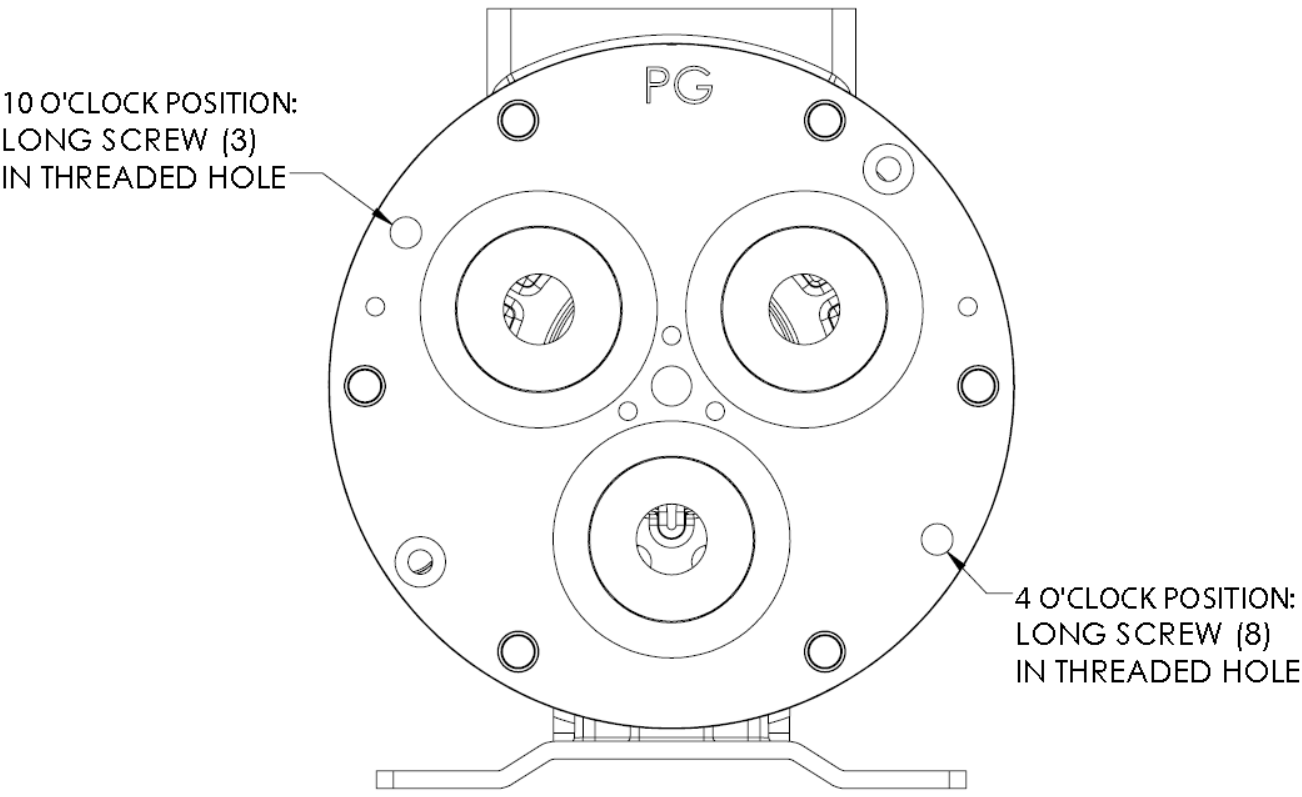
Note: Use the cap screw (29) at the 10 o’clock position on the cylinder casting to locate the valve plate. Place the "blind hole" of the valve plate over this bolt.
  1. Install valve plate (63) onto cylinder housing (40) and secure with two socket-head cap screws (58).
  2. Lubricate and reinstall O-rings (57, 59, 60) on the rear of the manifold (62).
  3. Place manifold (62) onto the valve plate. (Include support plate 66 for non-metallic models).
  4. Insert perimeter bolts (51) and washers (9).
  5. Torque Center Bolt: Tighten center bolt (52) to 45 ft-lbs (60 N-m).
  6. Torque Perimeter Bolts: Alternately tighten the six perimeter bolts (51) to 45 ft-lbs (60 N-m).
  7. Recheck all bolts for final tightness.

D/G10 Hydraulic End Service

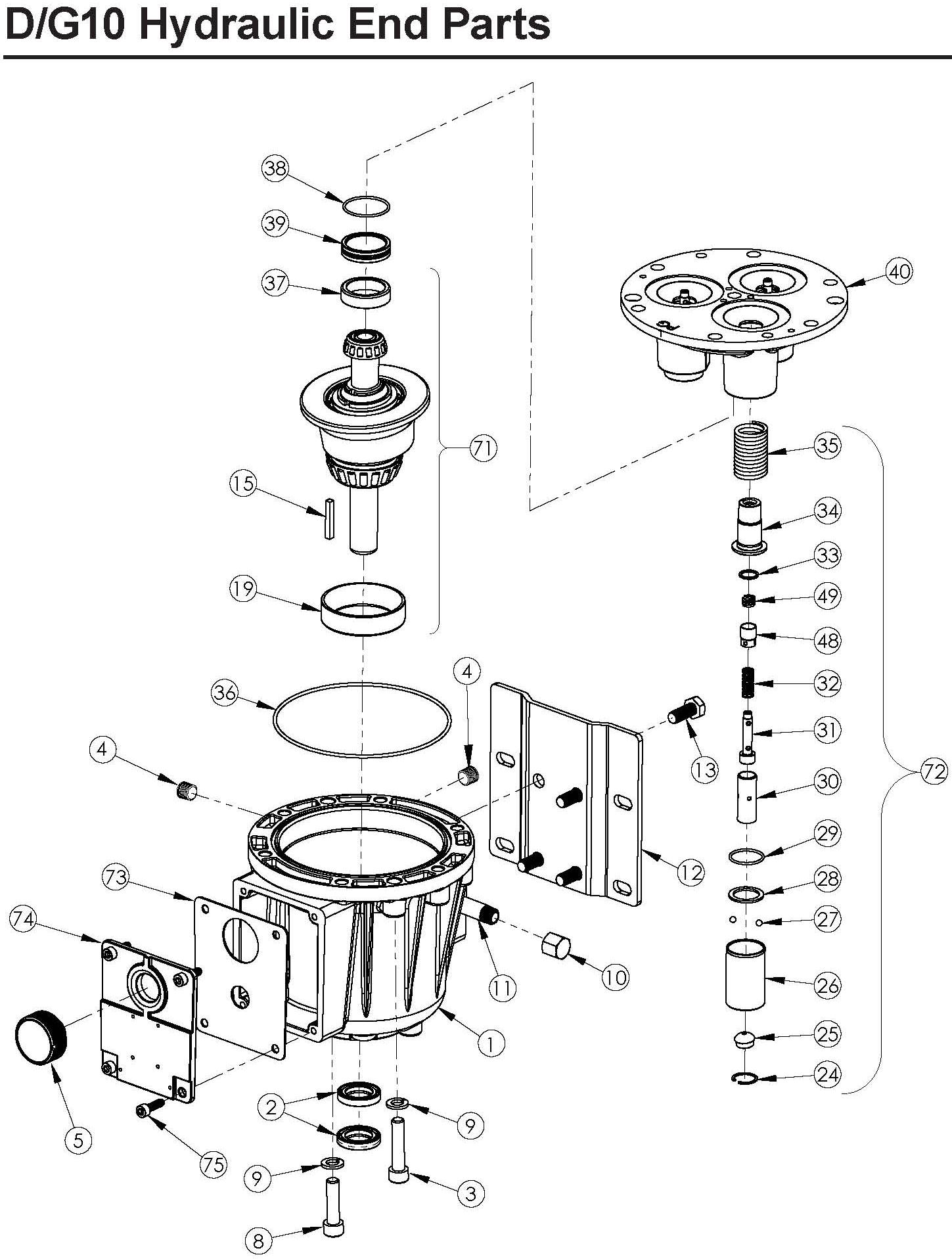
Note: The reference numbers in parentheses are shown in the Hydraulic End Parts section.

CAUTION: Do not disassemble the hydraulic end of the pump unless you are a skilled mechanic. For assistance, contact Wanner Engineering or your local distributor.
CAUTION: The two bolts (3 and 8) that screw through the back of the pump housing (1) into the cylinder housing (40) hold the two housings together. Do not remove these bolts except when repairing the hydraulic end. Note: When reassembling later, note that one bolt (3) is
1/4 in. (7 mm) longer than the other (8). The longer bolt must be installed in the 10 o’clock position of the cylinder housing (40).

Note: Wanner strongly recommends the use of the Wanner Tool Kit (P/N A03-175-1101).

1. Remove Pump Housing

  1. Remove the pump head and diaphragms as outlined in the Fluid-End Service Section.
  2. Drain oil from the pump housing by removing the pipe cap (10).
  3. Set the hydraulic end of the pump face-down on the cylinder housing (40) on a smooth, clean surface.
  4. Check the shaft for burrs. Smooth any burrs to prevent scarring the housing seals (64) during disassembly.
  5. Remove the bolts (3 or 8) that secure the housing to the cylinder housing.
  6. Lift off housing (1).
  7. Inspect cam and bearings (71), and bearing race in rear of pump housing. If bearings are pitted or binding, or if housing race is worn, replace them both.
    Important: Piston return springs (50) will force the cylinder housing and housing apart as these bolts are removed.

Model D10 Hydra-Cell Pro Pump Hydraulic End Service

D/G10 Hydraulic End Service (Continued)

2. Disassemble Pistons

  1. With the pump housing removed, set the unit on a flat surface, piston side down.
  2. Reinsert the follower screw (46) into the valve plunger (31). Tap the screw lightly with a hammer; the plunger (42) should slip off the valve plunger.
  3. Inspect all parts (54-56, 64, 65, 67). Replace all O-rings and any worn or damaged components.
  4. Repeat for the remaining two pistons.
Note: When reassembling, always use new plungers (42). They are press-fit onto the valve plungers and are not reusable.

3. Reassemble Pistons

  1. Drop ball (27) into the opening in the bottom of the piston assembly (26).
  2. Insert retaining washer (25) and O-ring (57) to secure the balls.
  3. Insert valve plunger (31) into the valve cylinder (30) and slide the spring (35) over the plunger.
  4. Insert O-ring (33) into the spring retainer (34).
  5. Slide the cylinder/plunger/spring assembly (30-32) into the spring retainer (34).
  6. Slide the complete assembly into the piston assembly (24, 25, 26).
  7. Insert the return spring (35), wide end first. Pro-Tip: This is a tight fit; turn the spring counterclockwise to seat it.

4. Reassemble Pump Housing and Cylinder Housing

Shaft Seal Inspection: Inspect shaft seals (2). If damaged, replace both. Clean the housing bore using emery cloth.

  1. Place cylinder housing (40) face-down on a flat surface.
  2. Insert assembled pistons. Ensure the holes on the foot end point toward the center of the housing.
  3. Stand the camshaft assembly (71) on the cylinder housing.
CAUTION: The pilot bearing MUST be properly nested in the bearing race. Misalignment will cause bearing damage and pump failure within the first hours of operation.
  1. Install O-ring (36) using grease/petroleum jelly to hold it, and slide housing (1) over the shaft.
  2. Use assembly studs (from the tool kit) to draw the housing down evenly. Monitor the shaft: Use the shaft rotator; if the shaft binds, back off and realign.
  3. Alternately tighten the nuts of assembly studs to evenly draw housing down to cylinder housing. Be sure O-ring (36) stays in place.
    Also, as you tighten nuts keep checking shaft alignment by turning shaft (use rotator in Wanner Tool Kit). If shaft begins to bind and become difficult to turn, back off nuts and realign shaft. When housing is tight against cylinder housing, you should be able to turn shaft smoothly
  4. Once tight, install bolt (8) at the 4 o’clock position and bolt (3) at the 10 o’clock position. Remove assembly studs.

D/G10 Hydraulic End Service (Continued)

5. Replace Shaft Seals

  1. Apply grease to the seal protector tool. Slide both seals onto the tool with the spring sides facing the open end. Apply a heavy coat of grease between the seals.
  2. Apply Loctite® Pipe Sealant with PTFE to the outer surface of both seals and the housing bore.
  3. Slide the protector tool over the drive shaft and use the seal inserter tool to press seals into place. Seat firmly with a soft mallet.

6. Adjust Cam Shaft Endplay

This procedure ensures the shaft has the required 0.006 in. (0.15 mm) of clearance.

  1. Remove and clean the three set screws (41).
  2. Insert center bolt (52) to push the adjusting plate (39) tight against the bearing cone.
  3. Back the bolt out two turns, then tighten it back against the plate.
  4. The "Quarter-Turn" Rule: Back the center bolt out exactly 1/4 of a turn.
  5. Rap the end of the shaft 3-4 times with a plastic mallet to set the endplay.
  6. Apply threadlocker to the set screws (41) and screw them in until they contact the bearing housing. Remove the center bolt.

7. Install Plungers

Safety Note: Always install new plungers (42) if they were removed; they are press-fit and non-reusable.
  1. Rotate shaft to Top-Dead-Center (TDC).
  2. Use the plunger guide tool to press the plunger onto the valve plunger (31). The plunger must be tight against the shoulder.
  3. Do not remove the guide until the diaphragm is installed.

8. Reinstall Diaphragms

  1. Pull the valve plunger up until cross-holes are exposed. Insert the plunger holder to keep it in place.
  2. Place diaphragm (43) on the plunger with the ridge-side facing out.
  3. Assemble the follower (44), new O-ring (45), and follower screw (46) with threadlocker.
  4. Torque: Tighten follower screw to 18 in.-lbs (2.0 N-m).
  5. Repeat for other cylinders, then refill and prime the pump.

9. Reassemble Pump Head

Reassemble the pump head as outlined in the Fluid-End Service Section (starting on page 12).

Model D10 Hydra-Cell Pro Pump Fluid End Parts

D/G10 Fluid End Parts List

D10-991-2400 Rev D
Ref No. Part Number Description Qty/Pump
9G25-048-2010Washer, Split lock8
41G10-082-2010Set Screw, 10 mm3
42D10-016-1010Plunger3
43D10-018-2312Diaphragm, Neoprene3
D10-018-2313Diaphragm, EPDM3
D10-018-2315Diaphragm, FKM3
D10-018-2320Diaphragm, Buna-N3
D10-018-2322Diaphragm, FFKM3
D10-018-2325Diaphragm, Aflas3
D10-018-2328Diaphragm, Butyl3
D10-018-2348Diaphragm, PTFE†3
44D10-017-1010Follower, 316 SST3
D10-017-1011Follower, Hastelloy® C3
45D10-047-2110O-ring, BUNA3
D10-047-2111O-ring, FKM3
D10-047-2112O-ring, NEOPRENE3
D10-047-2113O-ring, EPDM3
D10-047-2118O-ring, PTFE3
46D10-030-2010Screw3
50G10-084-1010Washer, Flat, SST1
51G10-024-2011Screw, Cap, soc-hd, M10, 80 mm6
G25-024-2010Screw, Cap, soc-hd, M10, 120 mm*6
52G10-081-2010Screw, Cap, soc-hd, M12, 70 mm1
G10-081-2017Screw, Cap, soc-hd, M12, 102 mm*1
53D10-038-2017Plug, Hastelloy® C, NPT1
D10-038-2210Plug, Brass, NPT1
D10-038-2211Plug, 316 SST, NPT1
G10-038-2017Plug, Hastelloy® C, BSPT1
G10-038-2211Plug, 316 SST, BSPT1
54D10-020-1010Valve seat, 17-4 SST6
D10-020-1011Valve seat, 316 SST6
D10-020-1016Valve seat, Tungsten Carbide6
D10-020-1017Valve seat, Hastelloy® C6
D10-020-3300Valve seat, Ceramic6
55D10-021-1011Valve, Nitronic® 506
D10-021-1015Valve, 17-4 SST, HT6
D10-021-1016Valve, Tungsten carbide6
D10-021-1017Valve, Hastelloy® C6
D10-021-3300Valve, Ceramic6
56D10-022-3116Valve Spring, 17-7 SST, HT6
D10-022-3117Valve Spring, Elgiloy®6
D10-022-3123Valve Spring, Hastelloy® C6
57D10-035-2110O-ring, Valve seat, Buna-N6
D10-035-2111O-ring, Valve seat, FKM6
D10-035-2112O-ring, Valve seat, Neoprene6
D10-035-2113O-ring, Valve seat, EPDM6
D10-035-2118O-ring Valve seat, PTFE6
58G10-088-2010Screw, Cap, soc-hd, 30 mm2
59D10-083-2110O-ring, Center bolt, Buna-N1
D10-083-2111O-ring, Center bolt, FKM1
D10-083-2112O-ring, Center bolt, Neoprene1
D10-083-2113O-ring, Center bolt, EPDM1
D10-083-2118O-ring, Center bolt, PTFE1
60D11-073-2120O-ring, Inner manifold, Buna-N1
D11-073-2121O-ring, Inner manifold, FKM1
D11-073-2122O-ring, Inner manifold, Neoprene1
D11-073-2123O-ring, Inner manifold, EPDM1
D10-073-2118O-ring, Inner manifold, PTFE1
61D11-074-2120O-ring, Outer manifold, Buna-N1
D11-074-2121O-ring, Outer manifold, FKM1
D11-074-2122O-ring, Outer manifold, Neoprene1
D11-074-2123O-ring, Outer manifold, EPDM1
D10-074-2118O-ring, Outer manifold, PTFE1
D10-109-2110O-ring, Outer manifold, Buna-N*1
D10-109-2111O-ring, Outer manifold, FKM*1
D10-109-2112O-ring, Outer manifold, Neoprene*1
D10-109-2113O-ring, Outer manifold, EPDM*1
D10-109-2118O-ring, Outer manifold, PTFE*1
62D10-004-1002Manifold, 316L SST, NPT1
D10-004-1008Manifold, Brass, NPT1
D10-004-1017Manifold, Hastelloy® C, NPT1
D10-004-1029Manifold, Duplex 2205 SST, NPT1
D10-004-1034Manifold, Cast iron, NPT1
D10-004-1050Manifold, Polypropylene, NPT*1
D10-004-1053Manifold, PVDF, NPT*1
G10-004-1002Manifold, 316L SST, BSPT1
G10-004-1008Manifold, Brass, BSPT1
G10-004-1017Manifold, Hastelloy® C, BSPT1
G10-004-1029Manifold, Duplex 2205 SST, BSPT1
G10-004-1034Manifold, Cast iron, BSPT1
G10-004-1050Manifold, Polypropylene, BSPT*1
G10-004-1053Manifold, PVDF, BSPT*1
63D10-003-1032Valve Plate, Reduced Pocket, Brass1
D10-003-1033Valve Plate, Reduced Pocket, 316L SST1
D10-003-1036Valve Plate, Reduced Pocket, Cast iron1
D10-003-1037Valve Plate, Reduced Pocket, Hastelloy® C1
D10-003-1038Valve Plate, Reduced Pocket, Duplex 2205 SST1
D10-003-1060Valve Plate, Reduced Pocket, Polypropylene*1
D10-003-1063Valve Plate, Reduced Pocket, PVDF*1
Request a Quote  or Call us at 908.362.9981 to speak with an experienced Hydra-Cell Pro pump sales engineer.

D/G10 Fluid End Parts (Continued)

D10-991-2400 Rev D
Ref No. Part Number Description Qty/Pump
64D10-023-1010Retainer, Valve spring, 17-7 SST, HT6
D10-023-1017Retainer, Valve spring, Hastelloy® C6
D10-023-2310Retainer, Valve Spring, Celcon®6
D10-023-2326Retainer, Valve spring, Nylon6
D10-023-2327Retainer, Valve spring, Polypropylene6
D10-023-2328Retainer, Valve spring, PVDF6
65D10-125-2327Washer, Dampening, Polypropylene*6
D10-125-2328Washer, Dampening, PVDF*6
66D10-100-1010Support Plate*1
67D10-092-2110Tetra Seal, Buna-N6
D10-092-2111Tetra Seal, FKM6
D10-092-2112Tetra Seal, Neoprene6
D10-092-2113Tetra Seal, EPDM6
D10-092-2118Tetra Seal, PTFE6
Torque and Threadlocker Requirements
Ref. No. Torque Loctite® No.
41242
4618 in-lbs (2 N-m)†242
5145 ft-lbs (60 N-m)242
5245 ft-lbs (60 N-m)
53567
* Indicates parts for Non-metallic pump head.
† Fluid end parts (44 - 46) are not used with PTFE diaphragms (43) part number D10-018-2348. Do not torque PTFE diaphragms (43), hand tighten only and apply Loctite 242.
Request a Quote  or Call us at 908.362.9981 to speak with an experienced Hydra-Cell Pro pump sales engineer.
Model D10 Hydra-Cell Pro Pump Hydraulic End Parts

D/G10 Hydraulic End Parts

D10-991-2400 Rev D
Ref No. Part Number Description Qty/Pump
1G10-001-1150Pump Housing A11
G10-001-1250Pump Housing Assembly A21
2D10-031-2110Seal, Buna-N2
3G10-087-2011Screw, Cap, hex-hd, 45 mm1
4D10-076-2250Plug, 1/4 in. NPT2
5D03-039-1030Cap with O-ring, Oil fill1
8G10-089-2011Screw, Cap, hex-hd, 38 mm1
9G25-048-2010Washer, Split lock8
10D10-078-2250Cap, Brass, 1/4 in.1
11D10-077-2250Nipple, Brass, 1/4 x 2-1/2” long1
12D10-025-1010Base plate1
13G10-029-2010Screw, Cap, hex-head, 25 mm4
15D10-085-2210Key, Shaft1
19D10-010-2911Bearing Cup3
24D10-050-3010Ring, retaining3
25D10-013-1010Foot3
26D10-014-1010Piston Body3
27D10-015-3010Ball6
28D10-041-1010Washer, Ball retainer3
29D10-034-2110O-ring, Buna-N3
30K10-043-1020Sleeve, spool valve3
31K10-044-1020Spool, valve3
32K15-045-3111Priming, spring3
33C23-009-2110O-ring, Valve cylinder, Buna-N3
34K15-042-1010Retainer, Spring3
35D10-019-3110Spring, Piston return3
36D10-037-2110O-ring1
37D10-011-2911Bearing Cup1
38D10-035-2110O-ring1
39D10-012-1010Bearing Adjusting Plate1
40K10-002-1252Loaded Cylinder Housing, Neoprene A31
K10-002-1253Loaded Cylinder Housing, EPDM A31
K10-002-1254Loaded Cylinder Housing, BUNA A31
K10-002-1255Loaded Cylinder Housing, FKM A31
K10-002-1256Loaded Cylinder Housing, PTFE A31
K10-002-1257Loaded Cylinder Housing, Aflas A31
K10-002-1258Loaded Cylinder Housing, Butyl A31
48K15-150-1000Bias spring spacer3
49K15-045-3110Overfill spring3
71D10-007-1210(X) Cam Assembly, 8 gpm @ 1450 rpm A41
D10-007-1214(E) Cam Assembly, 8 gpm @ 1750 rpm A41
72K10-014-1220Piston Assembly A53
73G10-106-2350Gasket, Cover1
74G10-105-1050Cover1
75G03-088-2010Screw, 20 mm4
A1 Pump housing includes housing (1), gasket (73), cover (74), and screws (75).
A2 Pump Housing Assembly includes housing (1), oil drain/plugs (4, 10), gasket (73), cover (74), and screws (75).
A3 Loaded Cylinder Housing includes Fluid End parts (42 - 46) and Hydraulic End parts (24 - 35, 38, 39, 48, 49).
A4 Cam Assembly includes: cam, shaft, wobble plate, and bearings (15, 19, 37).
A5 Piston Assembly includes: piston, piston foot, retaining ring, and items (24 - 35, 48, 49).
Torque and Threadlocker Requirements
Ref. No. Torque Loctite® No.
4567
10567
11609
1325 ft-lbs (35 N-m)609
Call us at 908.362.9981 to speak with an experienced Hydra-Cell Pro pump sales engineer for assistance

D/G10 Troubleshooting Guide

D10-991-2400 Rev D
Problem Probable Cause Solution
Motor/Pump Does Not Operate: No power. Supply correct power according to motor requirements.
Blown fuse/tripped circuit breaker. Replace/reset, eliminate circuit overload.
Shaft coupling to pump not in place. Install proper coupling hardware (see parts list).
Current overload - motor. Motor not rated for pump operating conditions - install proper motor.
Thermal overload - motor. Motor not rated for pump and/or ambient operating conditions - supply cooling or install proper motor.
Faulty motor drive/controller. Repair/replace.
Faulty motor. Repair/replace.
Low liquid level in supply tank. Fill tank (if low-level shut-off is used).
No Delivery: Supply tank empty. Fill tank.
Loss of prime. Reprime using Initial Start-Up Procedure.
Inlet line or strainer clogged. Clear debris and flush, or replace.
Inadequate supply pressure at pump inlet. Increase supply pressure by raising fluid level in tank, raising tank, or pressurizing suction tank.
Inlet line too restrictive. Increase inlet line diameter and/or decrease inlet line length.
Fluid viscosity too high. Reduce viscosity if possible (by heat or some other means). Increase inlet line diameter and/or decrease inlet line length. Increase supply pressure.
Vapor lock/cavitation. Increase inlet pressure. Decrease fluid temperature.
Pump valves held open or worn out. Clear debris and flush, or replace (see Fluid End Service).
System relief valve actuating. Adjust relief valve or repair, clean or replace with new relief valve.
Delivery Too Low and/or Erratic: Review all Probable Causes and Solutions in Problem 2, No Delivery above.
Air leak(s) in inlet line. Locate all leaks and repair.
System back pressure too low. Adjust back pressure valve to higher setting. Install back pressure valve if none in system.
Pumped fluid characteristics changed. Monitor supply tank temperature to determine if fluid is too hot (leading to cavitation) or too cold (increasing fluid viscosity). Stabilize temperature at suitable level. Check for entrapped air.
Inlet supply pressure changed. Monitor inlet supply pressure (at the pump) to determine if it is too low. Stabilize pressure at suitable level.
Oil condition in hydraulic end changed. Check oil level - if low, evaluate for source of leakage. Consult factory for hydraulic end service. Change oil per maintenance guidelines.
Delivery Too High and/or Erratic: System back pressure too low. Adjust back pressure valve to higher setting. Install back pressure valve if none in system.
Inlet supply pressure changed. Monitor inlet supply pressure (at the pump) to determine if it is too high, causing a “flow-through” condition. Stabilize pressure at suitable level.

D/G10 Wanner Tool Kit

Part No. A03-175-1101
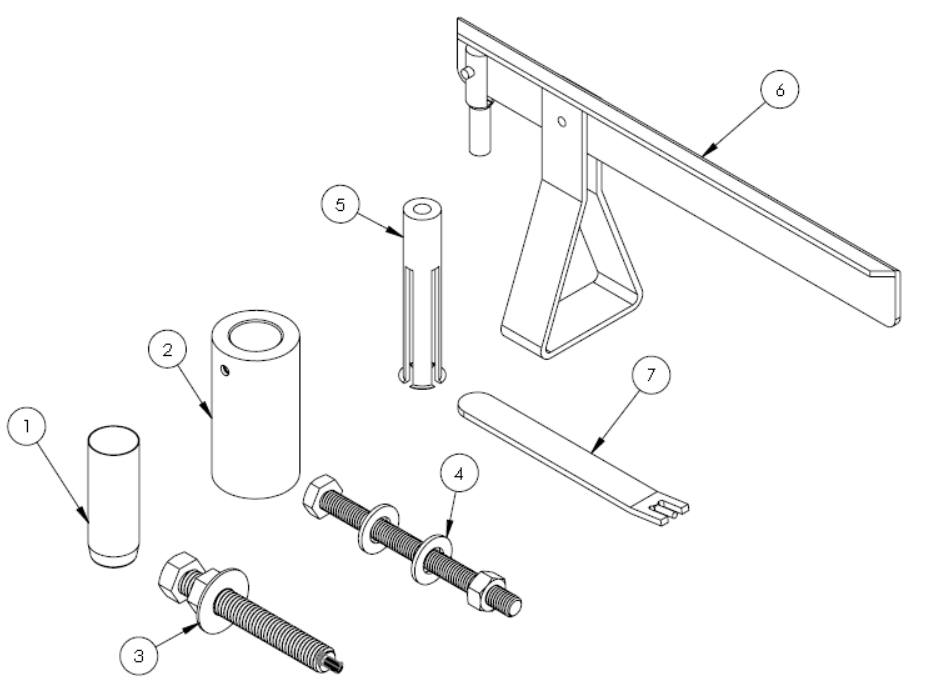
The D/G10 Wanner Tool Kit contains the tools illustrated below. These tools are used to assist in the repair and maintenance of the D10 and G10. See the Fluid End Service and Hydraulic End Service sections of this manual for specific application.
Note: Wanner strongly recommends the use of this tool kit when repairing or servicing the pump (available from Wanner or your local distributor).
Model D10 Hydra-Cell Pro Pump Tool Kit
Ref No. Part No. Description Qty/Kit
1A03-157-1000Seal, Protector1
2A03-159-1200Inserter/Shaft Rotator1
3A03-162-1200Plunger, Lifter1
4A03-156-1200Assembly Studs3
5A03-118-1000Seat Puller1
6A03-124-1200Seat Puller, Lever Assembly1
7A03-125-1010Plunger Holder1

- REMOVE ALL BURRS AND SHARP CORNERS.